

A Deeper Look at PlayStation 5 Pro's Updated PSSR | 19/08/26
We take a look at the recent presentation from SIGGRAPH to find out how it works.


Hello one and all and welcome to AI and Games. We’re putting the finishing touches to 101 things happening for us at Gamescom next week. In fact at the time of publication I’m about two days out from flying to Germany. Busy, busy, busy…
For this week I wanted to dig into a recent presentation about Sony’s PSSR upscaling tech. So we’ll do that now, and then next week it’ll be a pre-written game review issue as I’ll be knee-deep in stuff around Cologne and won’t have time to update you. That said, we do plan on having a Gamescom round-up issue on my return.
Okay, enough waffle, onward!
Follow AI and Games on: BlueSky | YouTube | LinkedIn | TikTok
Announcements
Some quick announcements for you including Gamescom, podcast, and conference videos!
A Quick Note on Gamescom
The AI and Games and AI and Games Conference teams will be on-site throughout the week. We hope to see some of you there, and please come and say hello - it’s always nice to meet our broader audience. Don’t forget we have the two tracks of AI content running Monday/Tuesday at Gamescom Dev. I’m going to be busy as I present in a couple of different sessions. You can catch me in a talk available to all attendees on Tuesday afternoon, whereas my appearance on a panel at the Leadership Summit on Monday is only available with a VIP pass. I’m also presenting at a couple of events behind closed doors, so don’t be surprised if you see me powerwalking from one side of the Confex to the other throughout Monday or Tuesday afternoon.
AI and Games Podcast #004 Drops This Friday
A quick note to mention we’ll have a new episode of the podcast this week, with games-journalist-cum-marketer Andy Kelly joining us on the show to talk about the updated version of Perfect Organism, the unofficial Alien: Isolation companion book. I spoke with Kelly back when we put together our retrospective video (see below), but this time around it’s about his experiences with the book including the drama surrounding the original publisher, it’s new home at boutique publisher Lost in Cult, what to expect in the new Assembly Cut edition, and of course… the trailer for Alien: Isolation 2.
New AI and Games Conference 2025 Videos
This week we have an Electronic Arts double bill with two interesting presentations from EA’s SEED research division:
Bringing Research to Life in AAA Game Production
Alessandro Sestini / Electronic Arts - SEED
We were fortunate to have Alessandro present at our 2024 conference, and this time around he’s back with a different presentation on something that’s seldom talked about: how does a dedicated R&D unit within a larger games company like Electronic Arts actually function? This talk provides a fun insight into how a team of AI researchers then collaborate with games productions to provide tools and help ship new features.
Variety in Autonomous Playtesting: a Case Study on Reinforcement Learning for NHL26
Florian Fuchs / Electronic Arts - SEED
Alessandro's talk was followed up by an example of how these collaborations can bear fruit. Florian Fuchs took to the stage to talk about the work SEED conducted collaborating with the devs behind ice hockey title NHL26 and how they trained machine learning bots to identify exploits and bugs in the logic for the AI goalkeepers running in the game.

AI (and Games) in the News
Some quick headlines from over the past week:
The Rideshare ‘Stimulator’ Drama Exploded:
After I wrote about Saber Interactive seemingly replacing a narrative designer with LLMs for their upcoming title Rideshare ‘Stimulator’, things kicked up a notch! After first gave a fairly standard response to this story that attempted to deny all knowledge of the situation, Saber’s CEO Matthew Karch kind of went off the rails first stating “Stella Who? I had to ask Claude because I have never spoken to her or seen her.", and then concluding a very ranty statement with “I would frankly in retrospect have been happy to replace her with AI. At least we would be dealing with someone programmed to be honest.” Blimey charley….
Since then the Steam AI disclosure has been updated to state exactly what Sacco had accused Saber of beforehand. With Saber then receiving what could best be described as a right drubbing on social media, Karch then took to apologise to Sacco privately, and has since accepted his apology publicly on BlueSky.Now the funniest, if not pettiest, thing about Karch’s rant was that Sacco stated on August 15th that Saber has only now revoked their access to the game on Steam despite being let go from the role in late 2023 - meaning that the developer build they had access to via their regular Steam account is no longer attached to their account. Having managed Steam access for fellow developers and publishers in a previous life, this requires someone to actively go in and find the license assigned to Sacco such that it gets revoked. That is some next-level pettiness right there. Clearly Karch figured out who Stella is, or their Steam id at least…
CGTrader is Seeing Lots of AI Uploads, But Nobody is Buying Them:
3D model marketplace CGTrader recently published their 2026 market trends report, and noted that while 17.6% of all uploads to their marketplace are flagged as AI-generated, they account for 2.6% of all sales, and 1.1% of revenue. Their customer survey notes that many users say the thing anyone who knows anything about AI-generated assets could tell you: they’re not good enough for most use cases, and often require manual editing to be considered close to effective.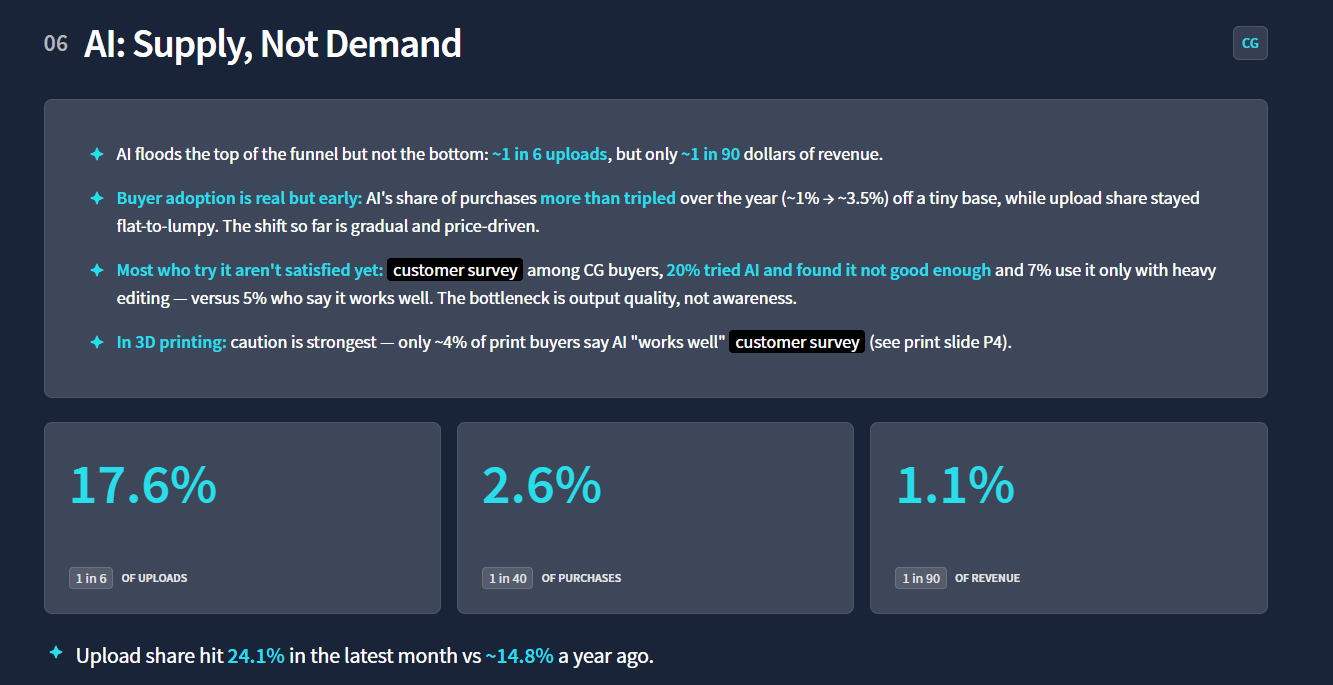
Source: CGTrader Market Trends 2026 Just How Much is Microsoft Lying About its Datacentre Expansion?
A great report from The Guardian trying to figure out just how close is Microsoft’s publicly-stated promises of datacentre building aligns with reality. The most interesting part is that the one datapoint the journalists consider the most credible when determining how much their statements meet reality is their sustainability reports, given they’re audited by a third party. Sounds to me like there’s a lot of Nvidia chips sitting on shelves somewhere…Uncharted’s Dynamic Difficulty Adjustment Was Designed to Give Value for Money(?)
Dynamic difficulty adjustment is a system that we frequently use in Game AI design in order to give the player a challenge. We’ve talked about it in our case studies over the years whether it’s for the likes of Left 4 Dead or Alien: Isolation, but in an upcoming podcast interview with FRVR Ben Russell formerly of Naughty Dog said that in the original Uncharted was added to the slow the player down. Noting that due to timelines and everything else, by the time they put the game together a good player could burn through it in 5 hours. So while all three games have a dynamic difficulty system designed into them, in the first game it was designed to ensure players didn’t complete the game too quickly, to quote:
“If you’re doing really good for the difficulty level you have it set on… it’s all time-based. We would do a bunch of focus tests and we would grab the average times per encounter. If you beat a combat encounter faster than the average that we had, we would start cranking the difficulty.”
Not very sophisticated, but sounds like it did the job!Immens Building Game Engines with AI?: In a piece over at GamesIndustry.biz there was the announcement of a new project in which three industry veterans are getting together to build an “AI-powered game engine”, whatever that means. I might sound rather facetious, but outside of this being a project where three developers are building a game engine using AI assistance, it sounds like the big innovation is that they’re architecting the engine such that it’s easier for AI agents to extend it. They’re promising a demo soon enough, so we’ll wait and see what it’s all about.

The Big Changes in PlayStation’s Updated PSSR Upscaling
PlayStation Spectral Super Resolution (PSSR) is Sony’s proprietary version of AI upscaling for rendering that we’ve seen over the years courtesy of AMD’s FidelityFX Super Resolution (FSR) and Nvidia’s Deep Learning Super Sampling (DLSS). While FSR and DLLS are built to run on specific Graphics Processing Units (GPUs), PSSR is built to run specifically on the PlayStation 5 Pro console.
It’s intended to run much like the other two systems, in that it renders games at lower resolutions originally on the hardware, and then uses the AI upscaling tools to reconstruct the image at a larger resolution with sharper details while also accounting for things like motion and lighting data in the current game state so as to ensure visual phenomena within the game is successfully reproduced. The technology received an upgrade earlier this year around the release Resident Evil: Requiem, with ‘improvements’ being made to the approach, though what they were and how it worked was a mystery.
So it caught my attention that last month at SIGGRAPH - the leading conference on developments in computer graphics - principal software engineer Daniel Craig took to the stage on behalf of Sony Interactive Entertainment to talk about the changes made to PSSR: PlayStation’s custom-built AI-upscaling technology. Now I’ll be the first to admit graphics is not my forte but I figured I’d walk through the presentation and talk a little bit about what was changing and why.
PSSR v1.0
The original version of PSSR was built as a means to achieve an AI-driven version of Temporal Anti-Aliasing Upscaling: a technique that blends both anti-aliasing methods designed to smooth edges, combined with upscaling for improved resolution. The goal being that by rendering at lower resolutions it frees up the GPU for more work in other areas. Since it was unveiled by Sony in 2024 as part of the PS5 Pro make-up, around 100 titles have shipped with PSSR support.
The launch PSSR was pretty much at the peak of what was being developed at the time in areas of AI-driven image upscaling, with work starting around 2020/2021 when even PC versions such as DLSS were still in their infancy. In fact, the research was leading development, given the hardware baked into the PS5 Pro wasn’t a done deal at that point, and was being built to service the AI models they were designing for PSSR. It was built on a type of convolutional neural network known as a Colour Prediction Network (CPN) that handled both the upscaling as well as Temporal Anti-Aliasing (TAA) for smoother edges. In amongst all of this it’s handling how to combine historical information over time, and how to ensure that the output is valid.
But one of the biggest problems in the original version is temporal noise. What we mean by this is that when you’re dealing with a lot of information that shifts with time such as particles like smoke and translucent materials combined with periodic shifts in light, it means that the PSSR struggled to render smoothly. When rendering at lower resolutions some of this temporal data was turning into noise and impacting the output. Note in the video above that in the original PSSR there is significantly more jitter in the space around the two neon signs, this was temporal noise coming into play as it dealt with low-frequency temporal shifts. As a result they needed to think about how to model them as the difference between original render resolution and upscaled target increases, notably at likes of 3x increase where you jump from 720p to 2160p. Plus there were also issues with colour depth given the neural network was operating at 8-bit efficiency, which isn’t ideal for calculating HDR colour values that are much higher precision.
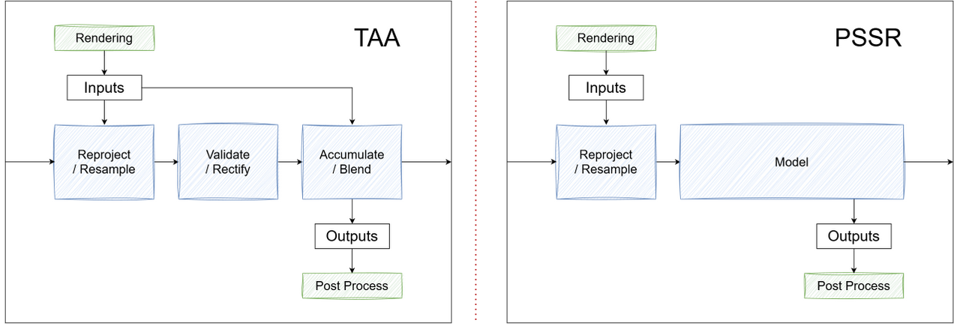
However, the more critical performance issue was in how to address these issues and others on an architectural level, given the entire pipeline was more or less now handled by a single AI model. It meant that the convolutional neural network was essentially doing too many things things as part of the process in a single system. In fact as Craig points out, the CPN was also having to learn a lot of the mathematical and filtering operations that not only do we have existing methods for this in TAA research, but are things that GPUs are very good at executing. In short, the CPN was doing too much work, and the things it was doing could be better achieved elsewhere, and let the AI focus on the bits it does best, which is learn to generalise overall the temporal and spatial information it was reading from the games rendered frames.
PSSR v2.0
One of the big challenges AI developers face when working in and around games is that we need to set deadlines or hard stops on the development of features such that we can ensure that the product goes out the door to customers. In this instance, the team at Sony had to draw a line on what was considered acceptable for PSSR at launch given they had to cement the hardware specs and ensure the models were ready for launch.
However this didn’t mean that R&D would simply cease. Rather there was plenty more work to be done, given the field of AI-driven upscaling was continuing to advance in the PC space while the PS5 Pro was shoring up for launch. However, one of the challenges was that this was continuing to increase the cost of execution, which more contemporary GPUs published by say Nvidia or AMD can accomodate for. This doesn’t really track with consoles given the PS5 Pro won’t receive another SKU update.
The solution was to actually revisit the core of how PSSR 1.0 worked, and strip back the behaviour of the system such that it does less. The internal CPN model now focusses on the maths necessary to ensure the image reconstruction works and retains all the important temporal and spatial information. However the actual reconstruction mathematics itself, which previously was inside the CPN, has now been pushed back into the GPU.
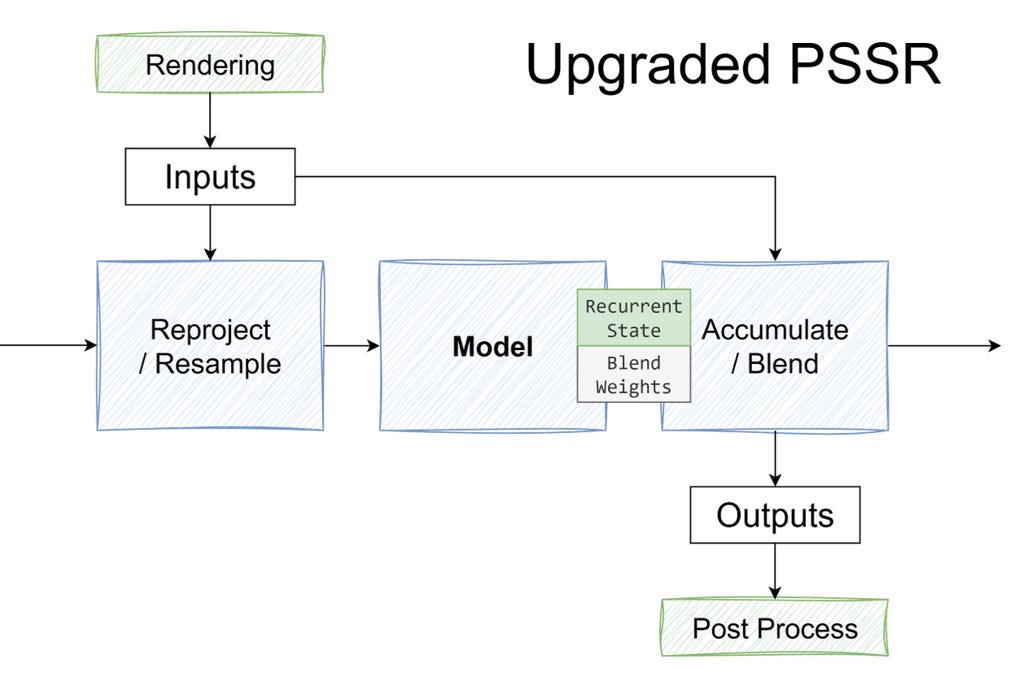
Given this reduction in workload, it also meant replacing the AI model inside the framework to no longer rely on a CPN and instead opt for a Kernel Predicting Network (KPN). A KPN is a form of neural network model that doesn’t generate the final pixel colours like a CPN, but instead calculates blend weights known as ‘kernels’ which provide help support denoise regions of local pixel-specific data. This is then sent to the final processing step to more accurately generate the desired pixel data.
All of this addresses allows for the AI upscaler and the TAAU to prove more effective when combined. Rather than have the AI handle both tasks, it handles how image reconstruction should work effectively, while the GPU focusses on the mathematics. This drastically reduces the workload of PSSR system at higher resolutions and allows for the model - specifically the KPN - to be structured such that it is able to dedicate more of its parameter distribution (i.e. the workload if you will of the model) towards handling management of data at lower resolutions. This results not just in finer details like those below, it addresses the temporal noise issues and also allows for better upscaling as it can better process data at lower baser levels of resolution and still achieve upscaling to 4K targets. Plus it made the whole thing much cheaper to train!
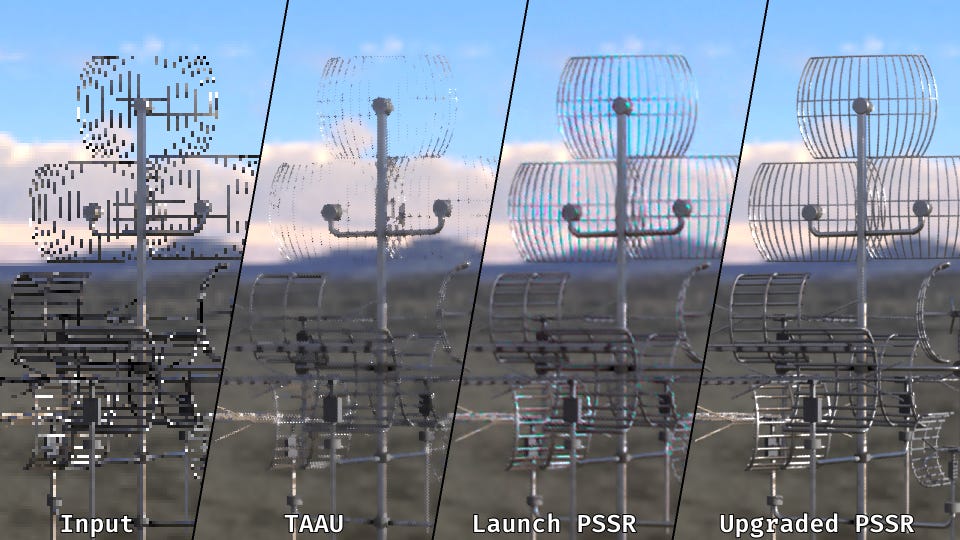
As I mention at the top, graphics is not my strong suit, so if this is your world then I’d recommend checking out the slides linked to earlier. Overall it’s a really interesting presentation, and the fact that they’ve went ‘backwards’ in a way that exploits where both traditional rendering and AI systems can better work together struck me as rather interesting. In the long run this should enable not just for better upscaling, given the model can now focus more on decoding images at lower resolutions, but this shift to lower base rendering will also free up the GPU more than PSSR already does. All things said, that’s pretty neat…
Wrapping Up
That’s it for this week. As mentioned earlier we will have an issue next week summarised some games we’ve been sent for review in recent weeks, but we’ll be back with a proper Gamescom post-mortem the week after that.
Take care and we’ll catch you soon.