

[Goal State] Pathfinding to Completion
Goal State - Backer Update: March 2026

In December of 2024, the first Kickstarter campaign for Goal State was 154% funded. Every month I will be providing updates on the ongoing work to complete the project, and deliver the end reward of complete video lecture and tutorial series on the foundations of AI for game development. While the original 30-day campaign has since closed, you can still sign up for late pledges via the Kickstarter page.
Hello all, and welcome to our first Goal State update of 2026. I had planned this for February, and then I blinked and the first quarter has almost wrapped. Good grief, so let’s fill you in on where we are.
Overall Project Update
Since our last update, we’ve had a bunch of small updates on what’s happening with Goal State:
We closed late pledges, and hit one more backer goal.
Now we’ll be adding the Half-Life deep dive to our public YouTube offerings.
We’ve been recording the theory part of the course.
We should have some of the first videos ready to review next month.
We’ve shared the current state of all of the completed theory writing.
With more chapters dropping this month.
Plus the tutorial code and assets are approaching half-way to completion.
At this point we have three of us all working not to turn the written work into the final assets, and should be in a position to start showing off the final videos in the next month or so.
Read the Completed Written Content
In our last update I mentioned that we have around 70,000 of the written work complete. As of this week we’re just over 100,000 words, and around 60% of chapters completely written. The state of these unfinished are a mixture of:
I want to do more research on relevant industry examples.
I just need to tidy them up and finish it.
In the case of 3 chapters (of 21), I haven’t started them.
But I wanted to show everyone where we are with this, so earlier this month on the Discord server I shared a link to be able to see and review the current state of all 12 completed chapters. Click here to access the document in the Overleaf editor (which is where I am predominantly writing the course).

There’s some key points to raise here:
This only includes chapters that are 100% content complete and only require spelling/grammar/accuracy review.
This version of the document includes 12 completed chapters, and is 208 pages and ~76,000 words long.
To give you an idea my progress in writing remaining chapters, the version I am working in as of this morning is 296 pages and ~101,000 words long.
If you have an Overleaf account and wish to be a reviewer, where you can leave feedback on parts of the material (see Liam’s great work on the left hand side), feel free to get in touch in the Discord and we can add you to the document.
When a chapter is completed in the main document, I will be transferring it across for you to check out.
The full list of completed chapters at this time are:
0-0 Welcome to Game AI 101
1-1 Foundations of AI
1-2 Computing Fundamentals
1-3 The Basics of Search
1-4 Tree Search Algorithms
1-8 A Brief Introduction to Machine Learning
2-1 Introducing Game AI
2-5 Finite State Machines
3-1 Designing AI for Games
3-2 The Value of Mixing Methods
3-3 Game AI as Theatre
3-4 Smoke & Mirrors
Right now my priority is to complete 2-2: History of AI in Games and 2-3: Pathfinding Algorithms in the coming week or so and add them to the document. After this I am finishing up 2-6: Behaviour Trees, and then 1-6: AI Planning and 2-7: Goal Oriented Action Planning.
The writing is admittedly a little scattershot, but that’s also because of the order in which tutorial materials are being prepared (which is in a slightly different order).
Recording Update
Right now recording is split across four axis:
Tidying up completed scripts for recording.
After all the written version doesn’t always translate into video delivery.
Recording the tidied up scripts.
As we get into our more meaty chapters, recording takes a couple of hours at a time such that we can get the quality we want.
Preparing the video content.
This means gathering from our existing assets, creating new diagrams, building presentation slides, or recording some of our demo code projects.
Editing the videos together.
A big part here is figuring out flow and how to break up material.
Rather than simply give you a chapter that is 1 hour and 10 minutes long, we break up the material into the corresponding section headers - or where it makes the most sense. So one chapter can be several videos in the final edit.
Right now we’re a little behind on recording, having only recorded about half what I planned by this time of year.
A Small Health Issue
In truth this process is more challenging than expected due to health problems I have experienced in the past year. I have suffered from an ongoing case of laryngopharyngeal reflux (LPR), commonly known as ‘silent reflux’. This is an ailment where an excess of stomach acid creeps up the throat and into the vocal chords. It affects your voice, while also leading to an excess of mucous / phlegm in the throat, and a sore throat.
Let me stress that, overall, I’m fine, and in good health. However LPR can have a severe impact on your voice and sadly that is my most precious commodity. After all in the past year I have gone around giving talks, engaged with clients, making YouTube videos and of course recording Goal State. But there are days where I can only comfortably use my voice in that ‘mode’ (anyone who knows me personally can attest the ‘YouTube voice’ isn’t my regular delivery) for an hour at best.
It has also meant my voice sounds deeper and more ‘croaky’. You may have noticed this particularly if you watched the episode on Amnesia: The Bunker last year where my voice is notably lower than usual (viewers even asked about it in the comments).
The good news is, I have been on a range of medication combined with small changes in diet in an effort to address this. I am generally a rather health conscious individual, but specific food, drink, and lifestyle can exacerbate this, and I’ve spent much of the past 2-3 months trying to get on top of it given the medication alone was not enough - and it was also causing side effects due to prolonged usage.
So this is a long way in saying, we’re still pushing forward, but this has slowed me done somewhat.
Practical Update
As detailed in the previous update, Andrew Roper has came on board to support getting all the tutorial materials up to my intended level of quality. Andrew is doing a great job right now as he builds the two strands of practical materials in parallel across two engines (Unity and Unreal). At this point most of the codebase is complete for the early segment of the course on uninformed and informed search algorithms, plus tree search algorithms (Minimax, MCTS), and the next step is implementing all the other pathfinding algorithms (Flow Fields, D* Lite, JPS etc.) in both engines.
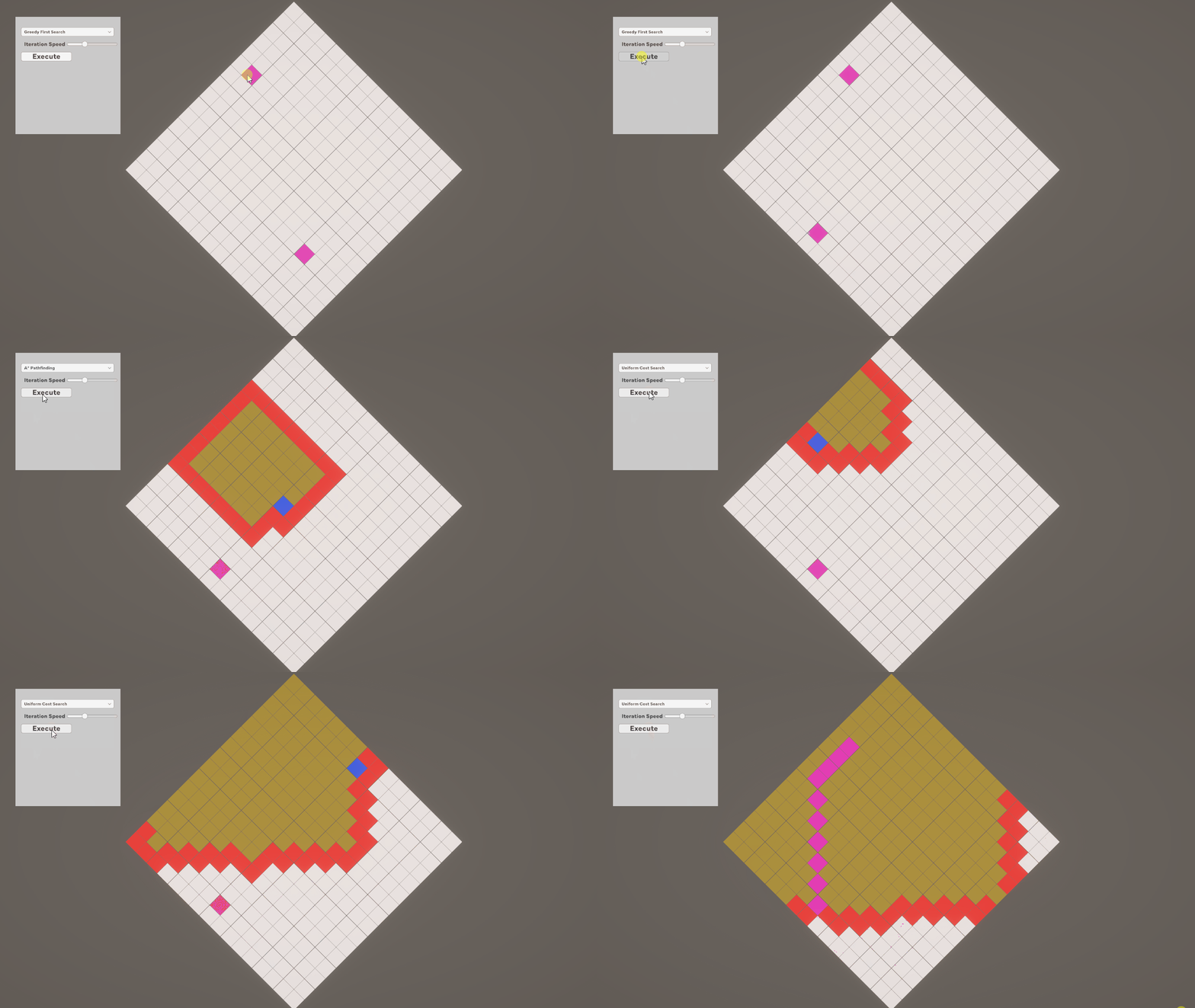
But here’s a little of some of the stuff we’ve designed in the Unity project. We wanted to be able to visualise how different algorithms work by visualising how states spaces operate. So these examples show we can run different algorithms in a grid structure and how it leads to us finding paths to states. Not here we show visited states (gold/orange), states in the agenda to be visited (red), the active state (blue) and then the path (purple).
Plus of course we want to get some Dijkstra’s in there given that’s also useful for pathfinding.
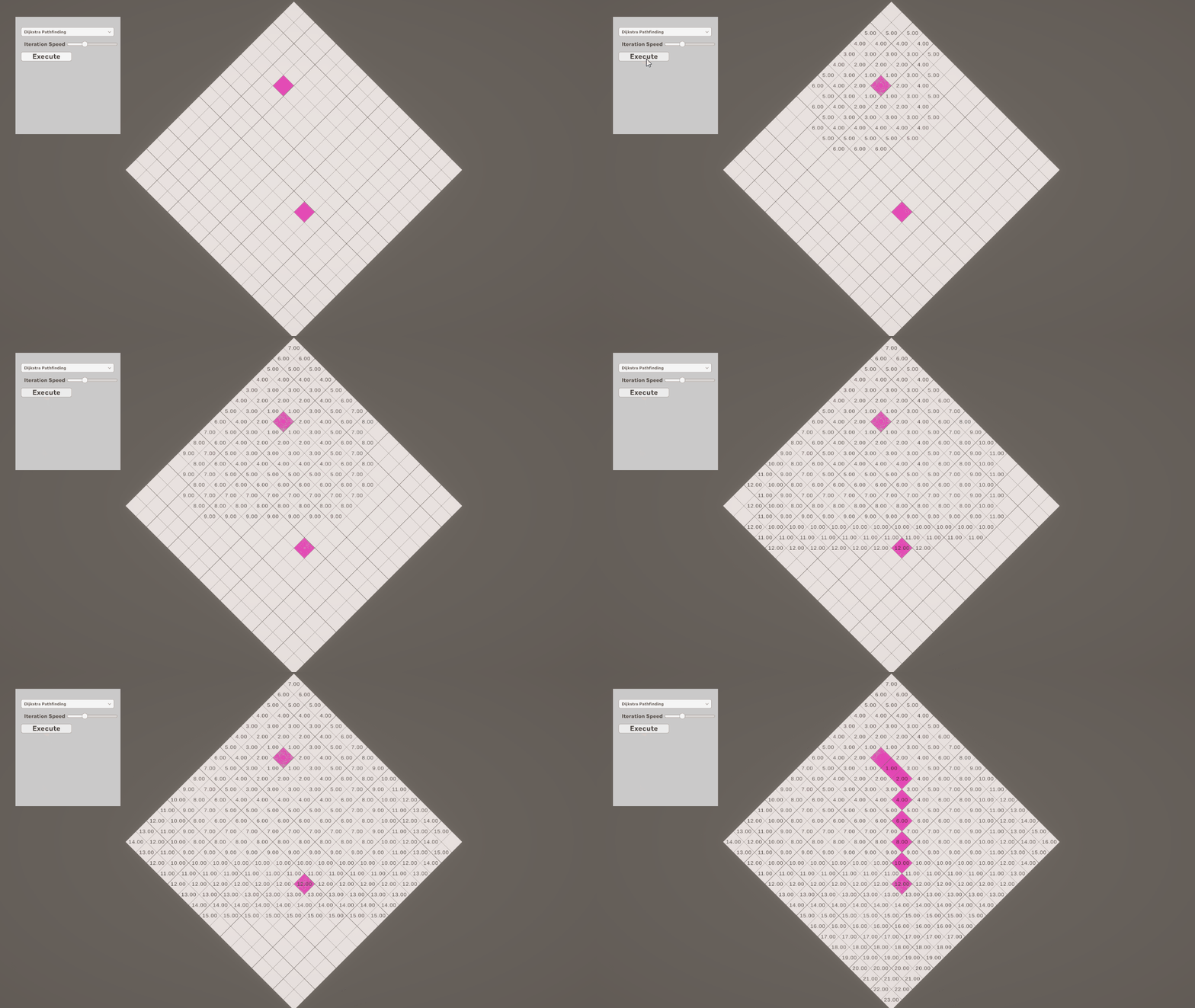
Right now the grid is rigid given in the pathfinding tutorials we start playing around with the space by changing its shape, and then you start seeing how these algorithms differ, and then as we go into in the pathfinding chapter we start allowing you to run A* with different heuristics, and then variants of the algorithm to get better results.
As I say, these are all implemented in both Unity and Unreal, and then for the tutorial videos we’ll be providing you with some boilerplate code to start, and then walk through to implement the algorithms.
We should have more to show on this as we continue to put it together.
Grab Your Desktop Wallpapers
One of the backer rewards that I’ve just forgot to get done - sorry about that. We have a collection of wallpapers using the background art assets we had designed for Goal State. You have two versions of each: one with the logo as shown above, and another with a smaller version of the logo in a more reduced format in the corner.
You can find them right here at this link. They’re available in 4K format (2160p). If you have a custom size that would be beneficial, then let me know and I can ask Andy (our graphic designer) to make some updates for me.
Wrapping Up
So there you have it. We’ve made a lot of great progress since the start of the year, and my hope is for the next update you can start to see more written material ready to review, and the first videos will be edited enough for us to show them to you.
It’s all finally coming together, and I have milestones set internally for what we want done for Goal State by end of Q1. So I better go make that happen!
-Tommy