

Separating Truth from Fiction in AI Surveys | 21/01/26
Facts are stubborn things, but statistics are pliable.

Maxon’s PR Aren’t Sure if Their New AI Tool is Even Real.
Valve’s Updated AI Disclosure is a Step Backwards.
How Surveys on AI Adoption in Games Never Tell the Full Story
The AI and Games Newsletter brings concise and informative discussion on artificial intelligence for video games each and every week. Including industry news, innovative research, emerging trends, and our own exclusive editorial and reporting.
You can subscribe to and support AI and Games, with weekly editions appearing in your inbox. If you'd like to work with us on your own games projects, please check out our consulting services. To sponsor, please visit the dedicated sponsorship page.
Hello one and all and welcome back to this weeks edition of AI and Games. This week we’re catching up on a topic voted for by readers last quarter on the AI surveys. I dig into some of the results coming out of surveys from Google, AWS, GDC and more and give a breakdown of what’s nonsense, what needs taken with a pinch of salt, and the things to keep an eye out for when another survey headline crosses your internet feed.
Follow AI and Games on: BlueSky | YouTube | LinkedIn | TikTok
News Round-Up
A quick summary of some headlines that cropped up in the past week.

Maxon Announces a new AI Tool at CES, Angering Consumers, and Confusing Staff
So this story dropped a week or so ago, but I heard a wee bit of inside gossip on it worth sharing. As discussed over at 80LV, Maxon - owners of 3D modelling tool ZBrush and animation tool Cinema4D - announced a new AI tool at CES 2026 for ZBrush known as ‘Maxon Digital Twin’. This tool promised to help turn any “3D product model into a marketing-ready asset”. So in theory you could take a CAD model of a product, and it would render it complete with appropriate lighting and backgrounds. Saving you the need to do photo shoots and the like for promotional works by building the object as a physical device/object/thing. Or of course getting a human to render it for you in an industry standard tool.
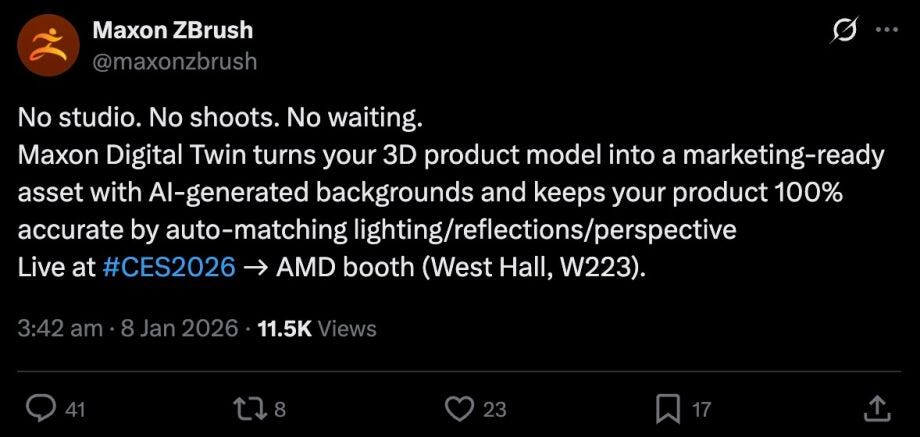
Now I say all this but this is rather speculative, given outside of a handful of posts on Twitter/X, it wasn’t exactly clear what Digital Twin was going to do. They announced it at CES, but with no demonstration on the show floor, just a promo video. But the announcement alone was enough to anger much of the ZBrush community, frustrated at AI being slapped into a tool with many outstanding issues and feature requests that users have asked to be addressed. Since then the original Twitter/X post has been taken down, and the website now implies that it’s a standalone product and not part of ZBrush.
What I learned from folks familiar with the situation was that a lot of people involved in the PR and marketing for Maxon were caught off guard by this announcement. Not only had they not been briefed that Digital Twin was a thing, but didn’t know what it is, what it does, or how it worked - which as you can imagine in their line of work is… a headache. People on the stand at CES were contacting the PR teams asking for guidance given the demo video (shown above) left more questions than answers. According to Maxon, Digital Twin is still in development. Whether it actually exists, is something we’ll find out in due course.
Valve Updates Steam’s AI Disclosure the Wrong Way
Last week industry commentator Simon Carless posted on LinkedIn stating that Valve’s AI disclosures as part of a games submission process on Steam has been updated. The form now removes the need to disclose use of AI tools that help make developers more efficient. The question on use of generative articiial intelligence now has the following description:
We are aware that many modern game development environments have Al powered tools built into them. Efficiency gains through the use of these tools is not the focus of this section. Instead, it is concerned with the use of Al in creating content that ships with your game, and is consumed by players. This includes content such as artwork, sound, narrative, localization, etc.
Does this game use generative artificial intelligence to generate content for the game, either pre-rendered or live-generated? This includes the game itself, the store page, and any Steam community assets or marketing materials.
Now contrary to most of the comments on this update on Carless’ LinkedIn post, I think this is a terrible idea for a number of reasons:
There is a baked assumption here that the person submitting the game understands the distinction between AI, machine learning, and generative AI, and to this day I find a lot of developers, much less players, are not in a position to answer this correctly.
It would really help at this point if Valve provided a clearly written statement on their distinction of AI/ML/GenAI for users to understand.
Removing this need to qualify ‘AI powered tools’ in game engines absolves developers of actually understanding what AI tools - if any - they’re deploying in their production. Naturally for a professional studio this won’t be a problem (identifying tools and their risks is a key part of pre-production), but for many indies and students this is a problem as they may not be aware of the tools they used in larger commercial products (say Unity, or Adobe Photoshop) and the implications that could have for them.
Furthermore, Valve make zero effort to contextualise what they mean by this. What are these AI tools they’re referring to? Give us examples of what might be considered exempt.
Stating that such tools only focus on “efficiency gains” when they’re interested in “[content] consumed by players” is disingenuous, given it can be argued that AI-generated code - which constructs the game itself - crafts the content consumed by the player. So this removes the need for developers to acknowledge use of code assistance tools, or whether they just vibe-coded the whole project.
It is stated above that part of the “content” is ‘the game itself’, but the question deliberately avoids providing ‘code’ as an example. Again, this is rather ambiguous.
It’s a willingness to avoid addressing the underlying issues of whether these ‘efficiency tools’ were built on copyright infringing materials. Sure you might have used a code generation tool, but where did it come from and why?
Yes the submission process states that your work is still subject to content rules - meaning don’t violate copyright law - but then efficiency tools are exempt from that? So a code generation tool that uses stolen assets is fair game? Bear in mind the GitHub Copilot class action lawsuit is still ongoing (though looks likely to be dismissed).
Also yes there is an implication that ‘AI tools’ mentioned here are not generative AI tools. But fun fact kids: you can still use AI to infringe on the rights of others without a generative model.
I’ve said it before, I’ll say it again. As consumers become increasingly more savvy to how different forms of AI work - and the implications it has in creative industries - they want more clarification on where and how these technologies are being used. Similarly, it’s important developers are aware of the implications of these technologies and take responsibility for that. All-in-all, this is a step backwards.
It strikes me this is an effort to walk back Steam’s own AI disclosures to avoid dealing with the granularity of the issue - which sadly doesn’t surprise me in the slightest. Another disappointing if unsurprising effort from Valve.
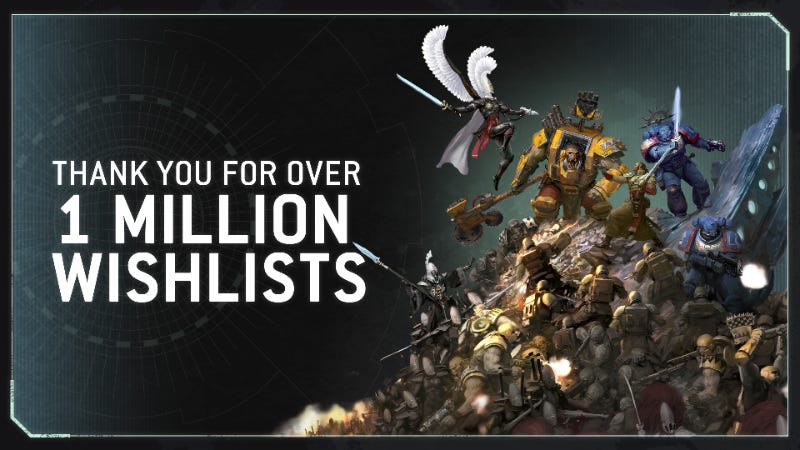
Total War: Warhammer 40k breaks 1 million Steam Wishlists
An impressive achievement for a game only announced back in December. We’ll be keen to see how the AI shapes up. No release date has been set by developers Creative Assembly, but fingers crossed we see it in 2026.
Our Main Story: Digging Into AI Surveys
We exist in a world where both really interesting and engaging work that is occurring in AI for game development, while equally many games studios don’t use it in any real way whatsoever. Given the current hype-laden landscape, it has meant there are broader efforts to advocate for and promote the narrative that AI is everywhere, everyone is using it, and if you’re not already then you’re behind the curve.
The games industry is fertile ground for this agenda. The sector has used AI in various forms now for decades. Combine this with the significant investment in new AI start-ups whose technologies promise to address the sectors fears over audience retention, faster content production, cheaper development, and overall stronger pathways to success. As we’ve discussed at length on this newsletter there is some truth to this, but we’re far from a point where there is clear consensus on what works and what doesn’t, be it from a fiscal, practical, or ethical standpoint.
As such, we’ve had a whole batch of surveys come out on in the past year telling us what the lay of the land is like: what percentage of developers are using AI, what they’re using it for, the demographics of users and much more besides. But more often than not there’s a bit of shady behaviour hiding within as numbers are fudged to suit the narrative.
But the truth is often hidden in the details. So I wanted to take a moment to look at some surveys, and discuss the common tactics adopted to help support particular narratives. In the hope that you, the reader, can more readily catch these issues if and when they’re presented to you. Including:
How the obfuscation of the term ‘AI’ helps support narratives.
Sample sizes and demographics seldom reflect the industry.
Understanding importance of who is responding to surveys.
How question design influences narrative.
Keep reading with a 7-day free trial
Subscribe to AI and Games to keep reading this post and get 7 days of free access to the full post archives.