

AI Slop Infects Game Promotion and Reviews | 04/03/26
Plus I recap my visit to the Gamescom Dev Leadership Summit


Metacritic Reacts to VideoGamer’s AI-Generated Reviews
TikTok Generating Inappropriate AI Adverts Without Permission
My time at the Gamescom Dev Leadership Summit
The AI and Games Newsletter brings concise and informative discussion on artificial intelligence for video games each and every week. Including industry news, innovative research, emerging trends, and our own exclusive editorial and reporting.
You can subscribe to and support AI and Games, with weekly editions appearing in your inbox. If you'd like to work with us on your own games projects, please check out our consulting services. To sponsor, please visit the dedicated sponsorship page.
Hey all, and welcome to this week’s edition of AI and Games. I’m back home after travelling to Lisbon for the Gamescom Dev Leadership Summit. So I figured as I try to get my working life back together I will catch up on the news and give you an insight into what it was like to attend.
Follow AI and Games on: BlueSky | YouTube | LinkedIn | TikTok
Announcement: Vote for Your Reader-Selected Newsletter Topic
It’s time to have another ready-selected issue of the newsletter come your way next month. While it was a tad delayed due to all sorts of editorial timelines, the first voted for issue was the breakdown of AI surveys and finding some meaning in amongst the various editorial spins being put together by various organisations.
I had some thoughts on what might be of interest for you all. Some are unselected topics from our last year’s poll, but also I added in some more current topics that might be of interest. Check it out below:
Comparing EU and South Korean AI Laws: As South Korea’s legislation comes into effect, how does it compare to the EU and what should games studios be wary of?
Digging into Steam Data on AI-Tagged Games: The number of AI-tagged games continues to surge on Steam, but are they actually making any money? We dig in to find out.
Explaining the DRAM Crisis and its Future: The recent surge in DRAM prices hasn’t emerged from nowhere. For the people in the know, this has been coming for a while now. How did we get here? And where are we going.
The plan is for the voted issue to be published around end of March/start of April. So get voting and we’ll make a judgement after the poll closes in a week’s time.

The Gamescom Dev Leadership Summit 2026
So yes last week I was out in Lisbon for Gamescom Dev (i.e. Devcom’s) leadership summit: a 3-day event positioned towards people in leadership across the video games industry. This ranged from the leads of smaller businesses, be they indie studios, co-dev teams or vendors, to the managers and C-Suite of some of the largest players in the industry. I was invited to be the closing keynote speaker of a bumper second day that included a variety of talks, roundtables, fireside chats and hot take sessions.

One aspect of these events is that they operate under a veil of secrecy. A non-disclosure is signed by all participants, and I am limited in how much I can report back to you. However, I want to stress that this is far less nefarious than it may sound if you’re not familiar with these types of events. An NDA is vital given many people here are discussing aspects of their business, be it strategy, performance, and upcoming products - in fact I spent over an hour at dinner one evening having a really fun discussion about the underlying tech behind a highly anticipated 2026 AAA title. But also they’re sharing their own thoughts about issues that affect our sector. Given the nature of this industry, should I report back on some of the things said, that could have an impact on that company for no other reason than the person involved expressed an opinion. Not because anything said was questionable or concerning - in most instances at least - but rather in a world where business leaders need to be seen as resolute, confident, and pragmatic, to reveal yourself as anything to the contrary - to be, dare I say, human - can have consequences.
It’s also a matter of trust. It creates a bubble of transparency and openness that wouldn’t exist elsewhere, and it was interesting to hear the thoughts of people who are in critical leading positions of some of the most beloved and successful franchises and studios in the world as they tell me about the things that keep them up at night.
I don’t sugar-coat it when I say it gives them sleepless nights: this was a point raised in presentations other than mine, and a recurring theme that emerged among attendees was the sense of validation in knowing that other people in similar positions are worried about the same things they are. As cliché as it sounds, it’s lonely at the top, and knowing what to do in the moment is daunting.
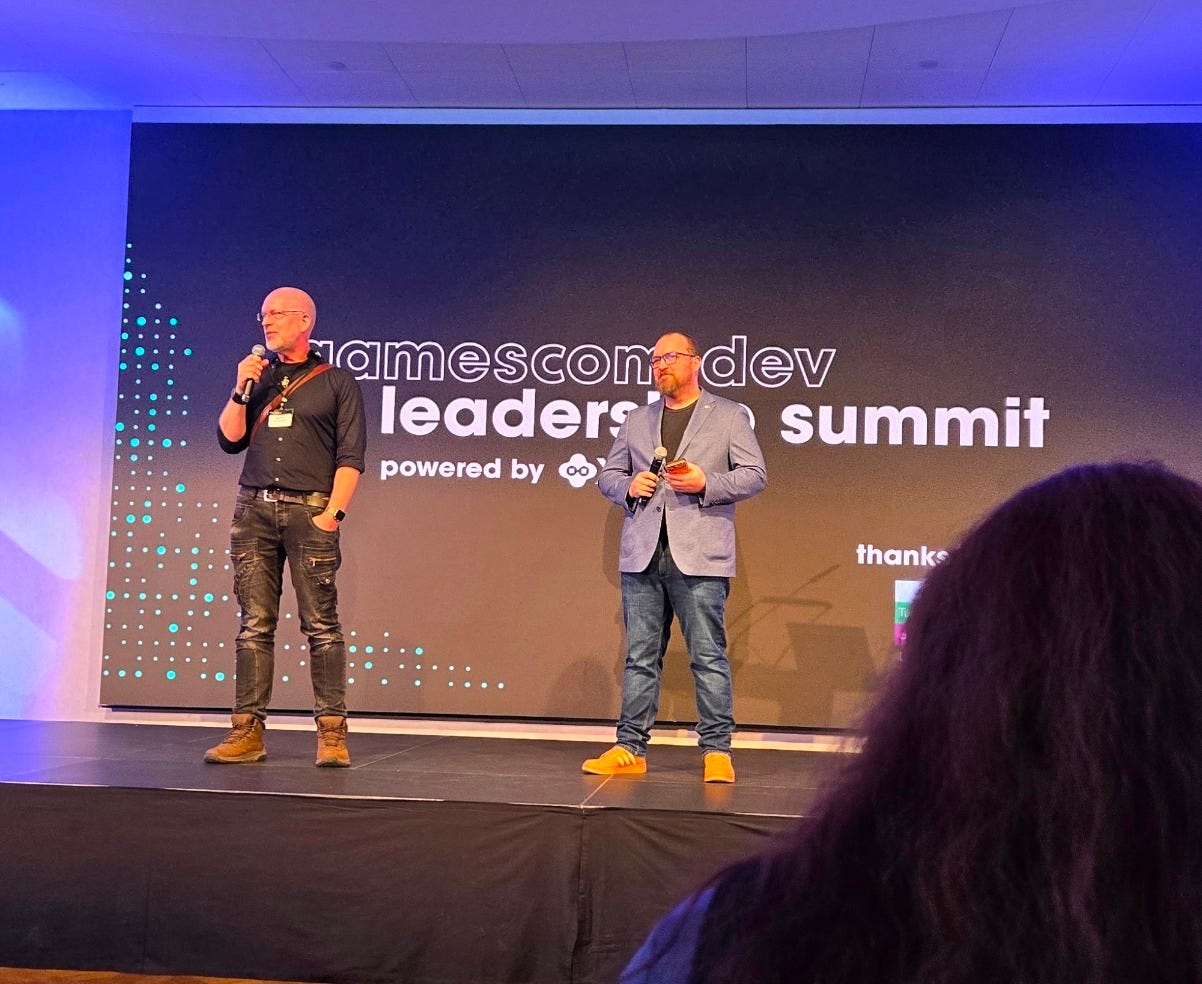
This segues nicely into my area of expertise: the boom of generative AI in the video games industry. I was invited both to present a talk on the subject, as well as be a roundtable captain alongside Tsahi Liberman. Having open and frank conversations about whether studios are using generative AI in their games, what their concerns are for its adoption, and what impact all of this could have in the long run.
It was encouraging to see that many of the conversations I had, be it during the roundtables, after my talk, or throughout the week, were focussed on issues we have discussed in this here publication in the past year or two:
Knowing where to draw the line on generative AI adoption. Focussing on generative AI in processes, but not in game production.
The importance of recognising need for good AI policy in studios.
Acknowledging the strong dislike of generative AI appearing in products in the PC and console spaces.
The lack of understanding and knowledge of whether generative AI will actually deliver value.
The long-term implications of embracing generative AI be it in player sentiment, flooding of the market, regulatory hurdles, and the quality of games.
Again, I can’t get into specifics, but it was encouraging to see a lot of the issues I raise are things that are being discussed at these companies, and that my presentation helped validate a lot of their concerns on how the industry is moving forward.
Ultimately it was a really interesting event, and a pleasure to get to hang out with a lot of really fun people who had been involved in the development of some of the biggest games in the industry. A thank you once again to the organisers for having me present.
AI (and Games) in the News
Let’s wrap up this edition with some of the headlines of the past week or two.
Publisher Finji Fights Back at TikTok’s AI-Generated Manipulation of Assets
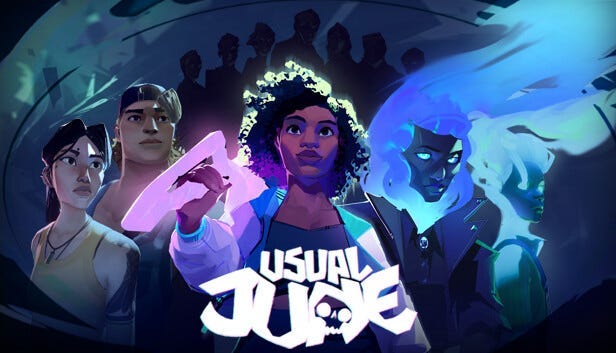
A really bizarre and quite disturbing story that broke on IGN last week was about game publisher Finji, famous for their involvement in titles such as Nights in the Woods, Tunic, and last year’s Usual June. Finji made public of an ongoing dispute with TikTok of using generative AI to create modified version of their advertising assets without their knowledge.
TikTok has AI features that allow for them to publish variations of your advertisement using generative tools so as to reach broader demographics. These are opt-in by default and Finji had refused to adopt them. However, CEO and co-founder Rebekah Saltsman stated that they have been in an ongoing dispute with the social media company in the past few months as it was creating adverts that showcased "sexualised, racist, and sexist representation" of the Usual June game from last year. TikTok initially denied being responsible for this, and now an investigation is underway.

VideoGamer Removed from MetaCritic After AI Review of Resident Evil Requiem
Once beloved gaming website Videogamer has fallen from grace in recent years. It had a strong following in its early days and had a team of rather eclectic voices who would subsequently go on to do great work in other areas of gaming press (including Chris Bratt who would later found the YouTube series ‘People Make Games’).
More recently the publication was bought up by the notorious Clickout Media, who are renowned for buying up sites to then fill them with SEO-optimised clickbait to push their advertisements towards gambling and casinos. During this time most of the staff were fired, with the intend to move towards maintaining a crew that essentially micro-managed AI.
Well, this all blew up last week when their review of the recently released Resident Evil: Requiem got the internet ablaze. Not just because it’s AI-generated nonsense - see the quote below - but also that it was still considered a valid publication on Metacritic.
Resident Evil Requiem is not just a victory lap for Capcom’s survival horror dynasty; it is a chainsaw-revving, blood-soaked testament to why we love getting scared stupid. It is the sort of finale that effectively grabs the franchise by the lapels, shakes it violently, and demands you acknowledge just how far it has come since the tank-control days of 1996. While other series limp toward their conclusions, RE9 arrives with the confidence of a Tyrant smashing through a brick wall.
I mean, I know not all games journalists are poets, but this is so cliché-laden and lacking in any nuance that you get the gist it was generated by GPT.
Further digging into this found that while the review clearly looks AI-generated, the author and their bio and headshot have been generated with GPT as well - plus those of other journos at the site. This has subsequently lead to Metacritic removing the publication from the site, and a statement being issued that highlights that their policy is to never include AI generated reviews, and will remove any publications found to be adopting this approach.
The shadiness of this aside, it’s important that Metacritic takes a stance on this given the (over-inflated) importance it has in the eyes of executives. Given it’s often used to highlight critical reception of titles in investor calls, and has also been the source for decision making in bonuses given to developers. AI content in this space has the potential to manipulate this process.
New Tool for Catching AI Disclosures on Steam
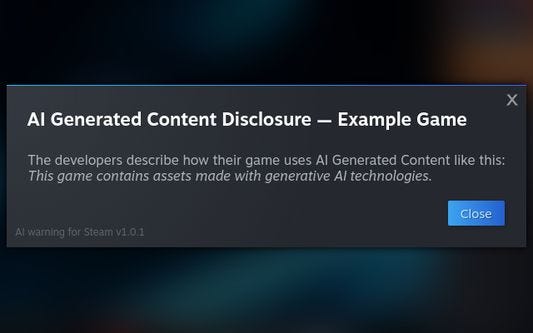
The recent Steam NextFest has once again raised questions surrounding the adoption of generative AI in PC games. To that end, an new browser plugin for FireFox and Chrome, entitled ‘AI Warning for Steam’ is built to identify whether a Steam page has an AI disclosure and put it front and centre in your face.
Should the disclosure be identified, it presents it as shown above as a modal pop-up, and blurs out the rest of the page until you have acknowledged it. Thus ensuring you know 100% that there was an AI disclosure for this game.
At a time where it feels Steam is de-emphasising the adoption of AI tooling - an issue I complained about a few weeks back - this is the consumers working to make it front and centre.
At the time of writing, this plugin now has over 4000 active users across Chrome and Firefox.
Wrapping Up
That’s it for this week. I’m still trying to get back into the swing of things after the Leadership Summit trip tired me out. But expect a Goal State update for backers by the end of the week!