

Capcom Lays Out Their AI Philosophy | 27/05/26
Plus I round-up some interesting indie titles I am playing while travelling.

Capcom Sets The Record Straight on AI Adoption
HoYoverse Announce Massive AI Investment Programme
Take Two Push Back on the AI Narrative
We Share the Love for Indie Games While Travelling!
The AI and Games Newsletter brings concise and informative discussion on artificial intelligence for video games each and every week. Including industry news, innovative research, emerging trends, and our own exclusive editorial and reporting.
You can subscribe to and support AI and Games, with weekly editions appearing in your inbox. If you’d like to work with us on your own games projects, please check out our consulting services. To sponsor, please visit the dedicated sponsorship page.
Greetings and welcome to this comeback edition of the AI and Games newsletter. I had a great time off on vacation, but there’s no rest for the wicked! After spending a week or so touring Italy (and speaking once again at Dev\Games in Rome), I am currently in Los Angeles as we wrap up a consultancy project with one of the biggest AAA studios out there (I’ll leave you to guess who that might be). In the meantime I figured I’d quickly round up some of the news that I stumbled upon as I returned to my desk yesterday, plus focus on reviewing some games I have played while I’m travelling!
Follow AI and Games on: BlueSky | YouTube | LinkedIn | TikTok

AI (and Games) in the News
Too much went down when I was offline. So here’s a round-up of the most interesting headlines.

Genshin Impact Developers Announce $14.6 Billion AI Investment [GameLook]
HoYoverse, creators of the highly popular Genshin Impact and Honkai: Star Rail have announced their intentions to invest 100 billion yuan ($14.6 billion USD) into AI infrastructure and deployment over the next three years. As we’ve reported before Chinese games studios are heavily investing in AI right now, but this story caught my interest because HoYoverse are focussing largely on building their own internal AI infrastructure, and removing the need to work with external providers. This comes at a time when everyone from Anthropic to Uber and everyone in between is realising that the financials of Generative AI are not improving. Token costs of running AI models are increasing, particularly in agentic frameworks. This is compounded by businesses not investing in their own setups, and instead relying on external providers who are now increasing how much they charge to customers - which don’t forget, they have heavily subsidised since day one. This is creating serious liabilities that companies need to address should this wish to continue using AI at this scale.
“AI is not for Creating Art” says Capcom [4Gamer.net]
In a recent interview with 4Gamer.net at the Google Cloud Next event in Las Vegas, Capcom’s VP of Development and AI Solutions Shinichi Inoue spoke of the company’s plans on how they’re exploring Generative AI and Machine Learning in production.
In a telling quote that was also pulled by VGC, Inoue-san states:
“What we in the entertainment industry consider extremely important in contrast to artificial intelligence is human sensibility. Even top-tier AI still cannot match our creators when it comes to sensibility. That’s the current reality. Because of that, concentrating human effort on work requiring this kind of sensibility is more efficient from the standpoint of human capital management, and it’s also important for coexistence with creators.”
Unsurprisingly this means focussing their technology in other areas where production can prove expensive and time-consuming and resolving “intermediate-steps” that lack human authorship and creativity, such as the likes of debugging and testing like shown below.
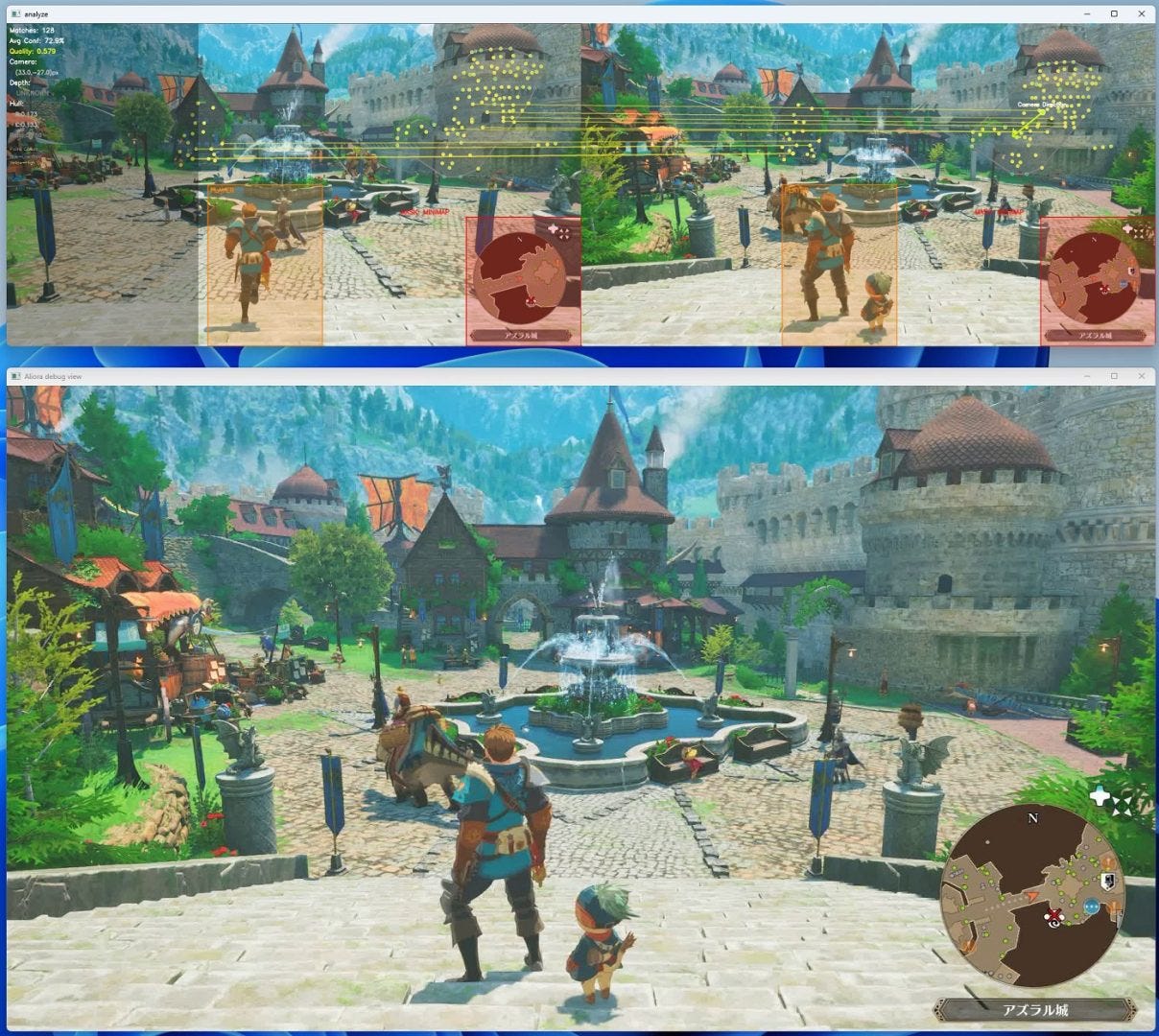
As Automaton Media points out, this contradicts Capcom’s previous efforts in this space. Notably their collaboration with Google Cloud on Generative AI for ideation of props and other background artefacts - a story we reported on in January of last year. Of course this was but one part of a larger effort to conduct research into the viability of AI in production, and perhaps lessons have since been learned?

For me, I see this as Capcom seeing an opportunity to quietly correct many of the narratives portrayed about their AI adoption in recent months. Be it Google stating Capcom was one of the major studios using their AI tools, to of course the DLSS5 debacle that dragged Resident Evil: Requiem into the firing line without their involvement. They’re aware of the issues arising from this, and the negative PR it can have on what is proving to be another stellar year for the company. So to rather diplomatically correct the narrative being presented and give their own insights makes sense.

I Begrudgingly Agree Once Again With Strauss Zelnick [GI.biz]
I’ve mentioned before that sometimes Take Two CEO Strauss Zelnick will express grounded/cynical takes on AI that I am prone to agreeing with. In his recent interview with Jon Hicks over at GI.biz he had the following to say:
“Technology is not going to take people’s jobs,” he says. “The big tech companies who laid off thousands of people and said it was because of AI were not telling the truth. It was because they overhired in the pandemic and they were sloppy about it and they haven’t addressed their headcount issues. And the market believing that all SaaS companies will go out of business because of AI – the market’s completely incorrect, as the market sometimes is. And if the market weren’t incorrect now and then, how could you invest in it? You’d never have an opportunity.”
“So I’m all in on believing that technology will evolve, and I’m all in on believing that it will affect us, and I’m all in on believing it could also create some threats – but I think generally speaking, this new technology is going to be very beneficial for our industry and for our company.” Hence, those hundreds of projects looking at how AI can be used in production, although he says none of them are “existential” bets. “Why would we? We don’t need to. What we’re betting on is creativity.”
Of course these comments come just weeks after the company let go an entire team who have spent years (first at Zynga, then at Take Two) working on exactly the sort of ‘AI for production’ projects that he so posits. So yeah…
Asus Enters the Ram Market in China
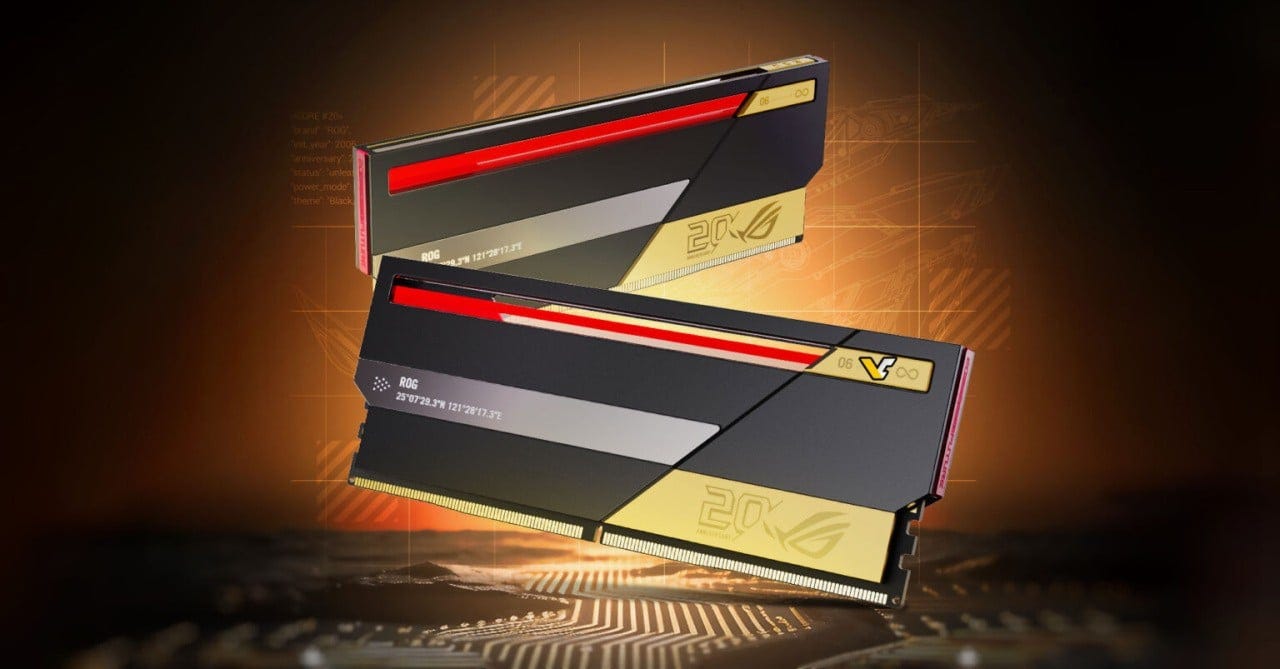
In an era where RAM manufacturers are leaving the consumer market for the sunny uplands of high-bandwidth memory for AI datacentres, it’s nice to see a new entry in the consumer market. Asus have announced the ROG Edition 20 48GB dual channel RAM. It’s um…. only around £600. It’s due for release sometime in June.
Ubisoft Pushing Forward with “First Playable Generative AI Experience” [Ubisoft]
While I was on the road Ubisoft was the latest games company to drop their full financial reports for the 25-26 fiscal year. While having a poorer year overall which is largely attributed to a lack of major releases and their ongoing ‘strategic reset’, they expect have more to shout about in the coming years. This summer we have Assassin’s Creed Black Flag Resynced, but also the company has promised new entries of Assassin’s Creed, plus the Far Cry and Ghost Recon franchises in the 27/28 and 28/29 fiscal years. In amongst all of this was the acknowledgement of their efforts to double-down on their AI efforts. Notably the ‘Teammates’ Generative AI demo that I was invited to try at an event in Paris last year. To quote the report:
Leveraging AI to enhance player experience and boost teams’ creativity and efficiency Ubisoft is accelerating investments behind Teammates, its first playable Generative AI experience, to enrich player experiences, while teams are making tangible progress organically on AI applications that can help manage the growing complexity of modern game development pipelines. This ranges from more intelligent bots supporting our QC teams, to smarter NPCs and game worlds that can adapt to player behavior and react more dynamically in real time.
The Group is fully leveraging decades of expertise in open worlds, systemic gameplay, and AIdriven systems, combined with years of pioneering AI and machine learning research through its La Forge R&D teams. Together with the many early adopters across its production teams, this gives the Company confidence in Ubisoft’s ability to remain at the forefront of this transformation and provides its teams with tools to enhance their creativity.
As they say, Ubisoft has been in the business of AI R&D for many years, so nothing here is a surprise. But it sounds like they’re doubling down on the Teammates project to see what kind of game can be built from it. If you missed my impressions on Teammates, go and read my report from attending the event last year.

Fireshine Games Won’t Work With Developers “Relying on Generative AI” [GI.biz]
Alex Forbes-Calvin recently sat down for an interview with Jasper Tanner-Barnes and Brian Foote from Fireshine Games who recently published the breakout indie hit Far Far West from Evil Raptor. One thing pointed out by the team was that the use of Generative AI notably for art and similar visual assets is a strict no-go for the company. To quote Foote:
"If AI means code completion or means using Copilot in Word, that's an entirely different set of scenarios. It will be very hard for anybody to say they're not touching AI in some way, shape or form, but in terms of the core game creation, that is not something that we think players are interested in at this point in time, and not something that we think is healthy for the development community."
I like to see when a publisher has a clear(er) line on this - heck, they have built a policy - on how to move forward. I’m inclined to agree with them on this, in that the PC/console market as a whole is not interested in a lot of what Generative AI has offered thus far. Studios still need to make a serious case for what value Generative AI can bring to the gameplay experience beyond chatbots and the removal of human labour.
Reviewing Indie Games on Tour
For the past couple of weeks I’ve been travelling around and to pass the time I loaded up a bunch of indie games onto my Steam Deck and Switch 2 and started working my way through them. So I figured why not report back on what I’ve played through and point you towards them should you find them of interest!
Outhold
Tellus Games / Steam
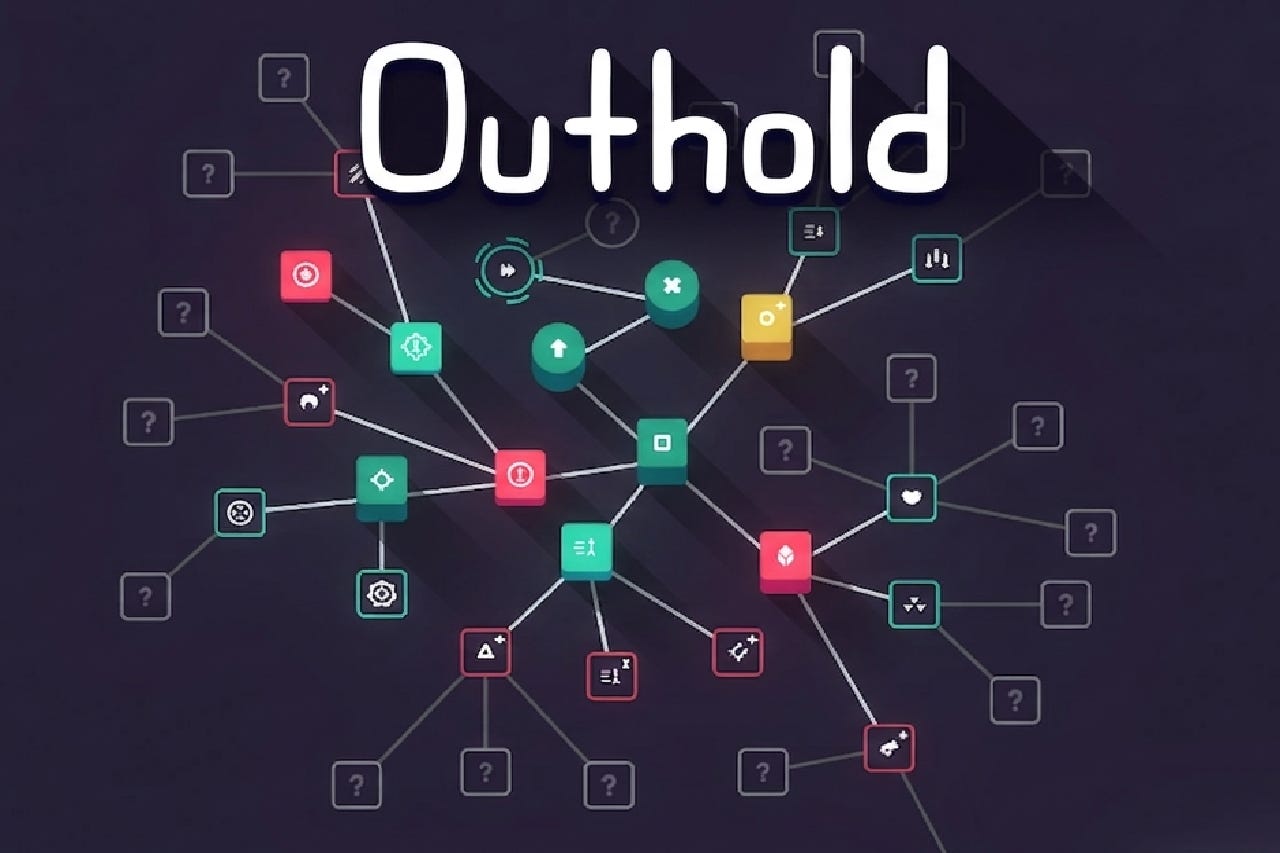
Released at the tail-end of 2025, Outhold is a tower-defence game with a twist. Rather than have the player go through a large number of levels complete with different map layouts and enemy configurations, Outhold only provides you with 10 levels, but with each significantly more challenging than the last. Through earned currencies either through regular combat or by completing specific challenges in each level, players then build out and expand a skill tree that allows for endless customisation of your playstyle and approach.
The skilltree, which the game gives something of a preview of in the title art, is massive in scale. Allowing not just for the introduction of new towers that have different effects (electric, fire, slowdown), but also to customise each of the towers around specific gameplay styles. Not every unlock is guaranteed to create a net positive effect, but it can prove useful if you merge it with other abilities. So for example you can increase the fire rate of your standard arrow tower while reducing the base damage, but then add the ability for elemental effects to be enhanced. The currencies accrued can be reimbursed at any time, and after you’ve achieved a certain level of success within the game, it allows for you to build multiple different loadouts. Hence you can have completely different loadouts built to handle specific styles of play, as well as particular configurations of enemies.
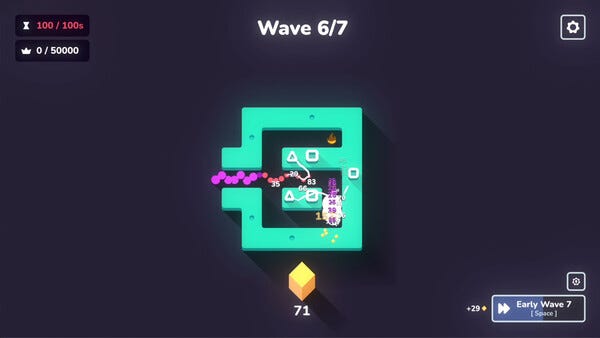
The enemies themselves are built around simple archetypes, and represented using simple shapes of various colours. Hence you learn quickly the difference between a small red dot and a big purple dot as you observe the damage taken and the speed with which they move towards your home base. While the behaviour is fairly rudimentary - move towards the goal fast or slow - there are a few surprises in there, and ones that will force you to rethink tower deployment strategies once you are aware of them. But the game lets you really relish the process of deciding how to take them on. Currency for building and upgrading towers is earned by eliminating enemies, though you start with a small (but upgradeable) budget at the start. This then leans into the challenge of each round and some of the challenges offered as you can be tasked to eliminate waves using only specific tower types, delivering a certain amount of elemental damage, or within a time limit. Waves can be prematurely triggered for a cash bonus that depletes the closer you are to regular deployment, and gives you the option to consider gambling your current configuration against the intensity of having two or three waves all overlapping at once.
What started out as a small addition to an existing Steam basket - after all it’s the price of a cup of coffee - Outhold has since became one of my Game of the Year contenders. It’s fun, lightweight, easy to play on desktop and Steam Deck (using the touchpads, it has no native controller support), and has a long endgame as more and more challenges open up. I’ve put it on hold for now having seen credits but plan to return to the more challenging corners of it later in the year.
Rainbow Legends
Unpixel Cloud Cedar Studio / Steam
Roguelike deck-builders are all the rage these days, with Slay the Spire 2 dominating the conversation in recent months, and I’ve been spending time playing The Killing Stone which we’ll hopefully run a case study on later this year. But in amongst all this came Rainbow Legends, a game that was blending deckbuilding with tiles. I have a bit of a fondness for tiles, and love me a good strategy game that uses them well. So was curious what this game brings to the table. In truth, it’s an interesting idea of using decks to dominate territory, that is let down by a rather complex and unclear deck system and a rather unforgiving onboarding process.
Cards in a players deck are designed predominantly to take over territory. The goal of a given turn is to play cards such that you take control of more territory than the opposing player. Doing so will result in the difference in score being applied as damage to their health bar. So if you have control of 32 tiles and they have 27, then you score 5 damage against them. Continue this process until you eventually wear their health down and they concede defeat.
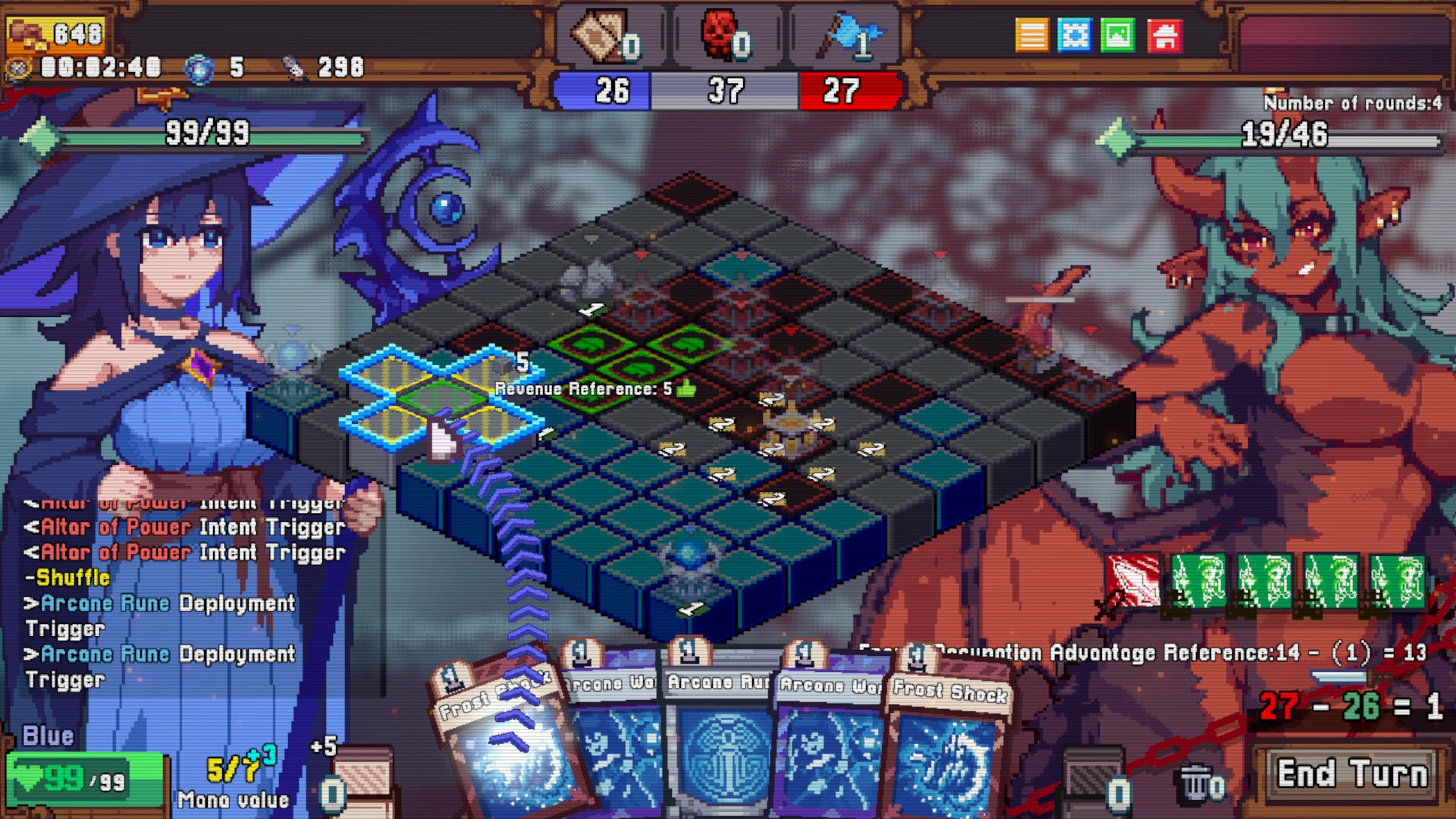
The game themes decks around specific characters who each unique abilities, ranging from providing elemental attacks, bolstering defences for later charged aggression, or propagating control over territory over time. Hence it becomes important to learn and understand what each deck does, and how to maximise its utility as well as learn to combat against it. This is both the games biggest strength, but also its largest weakness. It provides a lot of variety in the gameplay and allows you to try out different strategies and approaches over time. But it does little, if anything, to properly train you on how to prepare for a new enemy once introduced. Matches against boss characters have you face off against enemy players with their own decks that odds are you have not seen until that point, and they are incredibly aggressive in utilising them. I was curious how the game’s strategy AI would try and balance between opponents that simply go all-in on the strengths of their decks versus trying to create an experience where they make mistakes and open themselves to being exploited. In truth it is very much the former rather than the latter.
The bigger problem sitting alongside this is that the game doesn’t take the time to explain when new cards are coming into play and what impact that can have on your own strategy. You can figure this out by sitting at the turn stage and examining cards that have came into the opposing player’s hand, but it kills the momentum of the game, and often it’s not clear what a card will do until I see it in action. All of this leads to situations where I am in control for the first half of a battle only for the opponent to start dominating as new cards come into play, and from this point it’s seldom salvageable. I didn’t have many situations where I was losing a fight and then turned it around. Once the enemy AI has the upper hand, odds are you’re going to lose. This wouldn’t be so bad if the game used this to create a learning moment for me, or even gave me the option to restart the fight, but of course this is a roguelike. So I’m defeated, I’m back at the beginning, but I don’t feel like I’ve learned anything from the process.
While I have plenty of gripes with Rainbow Legends I don’t think the game itself is bad, or that the idea doesn’t have merit. But rather the onboarding experience and difficulty curve feel like they need a lot of work to feel engaging. The Steam reviews right now suggest that perhaps my perspective doesn’t quite align with that of others, but I found myself walking away frustrated without any desire to return. The game continues to receive hotfixes and balance changes, and perhaps with a few more patches the game will improve to a point I click with it a little better.
Luna Abyss
Kwalee Labs / Steam [Reviewed], PlayStation 5, Xbox Series S|X
Luna Abyss is perhaps the one game out of the three reviewed today that you might recognise. It’s getting a lot of buzz and for good reason. A first-person shooter that blends fast mobility with platforming, drip-fed narrative, and combat that leans into bullet hell design with enemies firing off shots in a wide variety of patterns and styles.
Despite my keeping an eye on games coming to market (after all, I’m always keen to find new case studies and interviews with developers) Lunar Abyss was below my radar until the presskit was bouncing around. However I realised upon closer inspection that I had seen the game before, and met a couple of the developers when they showcased at the Epic Games booth at GDC in 2024. The dark brutalist architecture and intense use of colour in the lighting - be it in the environment design or weapon fire - had stuck with me for the past two years. I didn’t play the game at the time but had watched over a friends shoulder, and the art style combined with what felt like an interesting mishmash of ideas from other games made it all the more memorable.
Luna Abyss has players take control of Fawkes, a young woman imprisoned on the dark ‘mimic moon’ of Luna. Sentenced for crimes against the state, you are forced to serve your sentence of roughly 9000 days as a warden who explores the megastructure within this red moon. What you find is a destroyed civilisation and remnants of a once prosperous city filled with a serious of quirky and esoteric characters (all of whom laying it on thick with British accents). As the story progresses you fight your way deeper into the abyss, and ponder how to respond when it starts whipsering in your ear…
The conversation orbiting around this game (no pun intended) has been to proclaim Lunar Abyss as Returnal meets the modern Doom games with a hint of Metroid Prime, and it’s hard to disagree with (some of) that. Players navigate through a series of platforming segments until they reach combat arenas where waves of enemies will spawn. Each enemy archetype has a different attack style, be it in whether they maintain distance to the player, and how they seek to deal damage. Much like Returnal these shots are typically orbs of energy that players must avoid as they are fired off in patterns, ranging from small clusters of shots to larger and more consistent waves and shapes. Locking onto targets just like in Metroid Prime can help you maintain the pressure as you bob and weave around the projectiles being fired, and even execute a Doom-style glory-kill execution that works at range to kill an enemy and give you a little bit of health - plus an upgrade that swaps out the health absorption for turning the enemy into a bomb that damages nearby foes. However if the pressure is too much you can back off and rely on your parkour abilities such as double-jumps and dashes that you unlock gradually throughout the campaign.
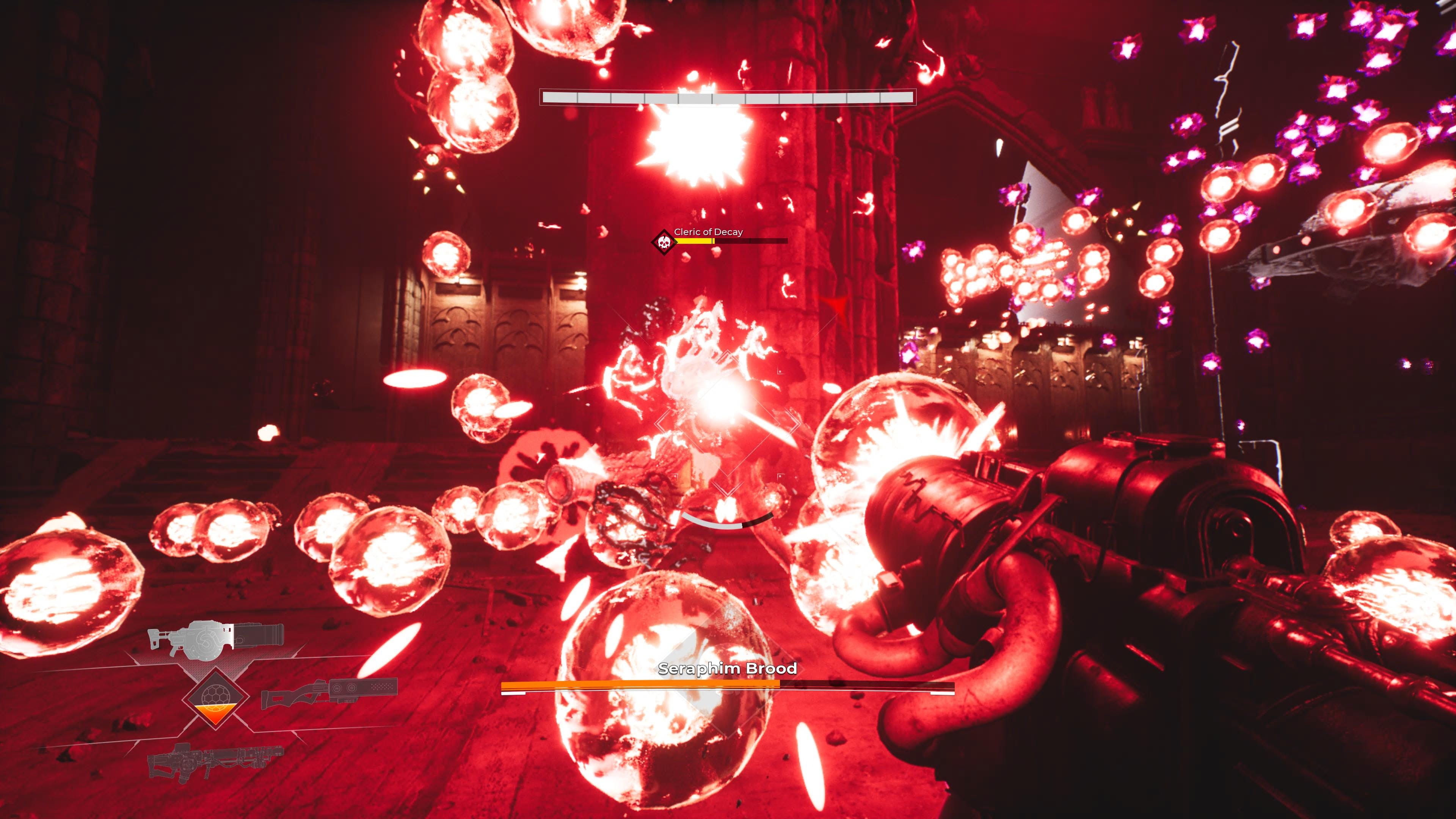
Unlocks for movement and combat gradually increase you agency, and the game’s enemies scale up alongside it. Combat starts out as a more static process whereby you stay on one side of the arena, lock-on in a style akin to Metroid Prime, and fire as you weave around projectiles. However, over time it becomes increasingly chaotic as you move around the environment to find the right time to strike. Be it by dealing big damage with the ‘Atom Splitter’ rocket launcher, or being forced to break an enemies shields with the shotgun-coded and appropriately named ‘Shieldbreaker’. That said, sometimes it all becomes simply too overwhelming, and stopping in the moment can prove not so much fatal, provided you find cover, but kill all of your momentum as you hide behind a pillar and are forced to take pot-shots from afar.
The gradual introduction of new mechanics, or expansion on existing ones, is welcomed but also I feel a little too slow. I am picking up these new additions and embracing them fairly quickly, and would like for the game to offer up some more meat to the combat faster than it does. For more seasoned players it takes a little while to start presenting a more intense challenge, but where I am now in the back third I feel like it’s pushing me just the right amount.
The comparisons to Metroid Prime and Returnal do the game something of a disservice, in that they suggest the game is either a Metroidvania or a roguelike, when in truth it is neither. It’s straightforward linear narrative game broken up into six chapters. I have yet to see credits, but the overall story and world design has helped maintain my investment and propulsion towards the end. The art design is pulling from numerous directions, with a mixture of cyberpunk, steampunk, brutalist architecture and a dash of cosmic horror. The world design actually reminded me just as much of Bungie’s Destiny games as it did Metroid Prime, with both an interesting contrast between the brutalism and nature in specific segments, combined with strong use of lighting in the art direction. It looks great even on the Steam Deck - which accounts for around 80% of my playtime thus far - and looks even better when you throw even more graphics power behind it on the big screen.
Right now Lunar Abyss is creeping into my top 10 for the year. I don’t think it excels in any one particular area, and there are faults to be found in some of the combat design, alongside the platforming and pacing, but it does everything at a sufficient level of quality that it elevates the overall presentation. I’m not sure if it will stick it out to the end of the year GOTY list, but it’s certainly one of the best first-person shooters I’ve played in 2026.
Disclosure: Rainbow Legends and Luna Abyss were reviewed courtesy of a pre-release Steam keys provided from the publisher via Keymailer.
Wrapping Up
Alrighty, that’s it for this week. I’ve got more games to report back on when I return to the UK - we might even stream some of them when I’m back at my desk. I’ve got a brief return back to the office next week before I fly out once again on another work trip to Berlin.

But the good news is next week we’re announcing our plans for the AI and Games Conference 2026! Stick around for that. Plus later in June we’re announcing a new project that we’re launching with a bumper line-up of guests and topics, you’re going to love it!
Thanks for reading, and catch you next week.