

Game AI's Existential Crisis [Part III] | 26/03/26
In our closing entry, we discuss the challenges of community building, and how we can work for a better future for Game AI.

The AI and Games Newsletter brings concise and informative discussion on artificial intelligence for video games each and every week. Plus summarising all of our content released across various channels, like our YouTube videos and in-person events like the AI and Games Conference.
You can subscribe to and support AI and Games, with weekly editions appearing in your inbox. If you'd like to work with us on your own games projects, please check out our consulting services. To sponsor, please visit the dedicated sponsorship page.
Hello one and all and welcome to this (slightly delayed) edition of AI and Games. I wanted to spend this week wrapping up the Game AI Existential Crisis series I started writing last year. Admittedly this was tough to commit to given so much has happened in the past week news-wise, but we’ll come back and summarise all of that next week.

Announcement: Participate in the Industry Day at IEEE CoG 2026
A quick announcement before we get into the meat of things. The IEEE Conference on Games - the largest academic conference dedicated to research in games - is hosting a dedicated industry day as part of a four-day event running from September 1st to 4th at Universidad Complutense de Madrid in Spain. You may recall I wrote about attending in 2025 as a keynote speaker. This year I have joined the organisational committee as industry chair.

Naturally for my academic friends this will be something they’re already aware of, given it is a highlight of the event calendar. But I wanted to raise this for our folks out in the games industry who fancy taking part. As we’ll have a day full of keynotes, presentations, plus a demo exhibition.

We currently have an open call for talks, demos, and sponsorship for the event. Full details can be found at the site. Participants do not need to submit a research paper like their academic colleagues. Just a short abstract and takeaways is all that is required. Whether you’re indie or AAA, if you have some interesting work you’d like to present to a captive audience, this is a great opportunity.
Also, let me stress, this is not a solely AI-focussed event. So you don’t need to be working on AI for games to submit.
Deadline is on April 10th. Feel free to get in touch if you have any questions!
Follow AI and Games on: BlueSky | YouTube | LinkedIn | TikTok
Game AI’s Existential Crisis Part III: On Building Community
At the end of October last year I wrote the first part of my essay on Game AI’s existential crisis. A longform breakdown of the challenges facing in Game AI: the discipline of artificial intelligence used for gameplay in the current video game industry.
Please note: this series is focussed exclusively on Game AI, and I am not discussing broader AI applications in production be it machine learning or generative AI.
I believe that Game AI as a field has three distinct challenges it needs to address as a community in the coming years.
![Game AI's Existential Crisis [Part I] | 29/10/25](https://substackcdn.com/image/fetch/$s_!ERGx!,w_140,h_140,c_fill,f_webp,q_auto:good,fl_progressive:steep,g_auto/https%3A%2F%2Fsubstack-post-media.s3.amazonaws.com%2Fpublic%2Fimages%2F069186f0-5ef7-4ced-962a-70af65c071e5_3840x2742.jpeg)
In part one I gave a broader introduction to the subject matter for those new to game AI, and discussed the first challenge in that Game AI is struggling on a technical and design level in the current climate. In particular discussing the ever-increasing demands of contemporary game design and development, and how generative AI is often incorrectly hailed as the solution to our problems.
![Game AI's Existential Crisis [Part II] | 17/12/25](https://substackcdn.com/image/fetch/$s_!cOhA!,w_140,h_140,c_fill,f_webp,q_auto:good,fl_progressive:steep,g_auto/https%3A%2F%2Fsubstack-post-media.s3.amazonaws.com%2Fpublic%2Fimages%2F5f79afc7-1559-4b62-b981-45d6089d4986_3840x2742.jpeg)
Then in part two just before the winter break, I expanded on this thesis to discuss the challenges faced in education and access to knowledge. How so many of our institutions have been lost over the years, how our knowledge is fractured, and the realisation that my work AI and Games is now the longest-running venue for information on AI in the games industry, and Game AI in practice. While this is something I am very proud of, I am equally horrified that this has come to pass.
For this third part I want to talk about community. There is a community of developers who have been in and around the space of Game AI for some time now. Some of you might be just joining us by finding my work online (welcome), while others have been in this space for decades. It is important that we continue to find ways to connect with one another, and foster that community as priorities shift in various aspects within the industry.
So for this edition, I want to focus on the following:
The importance of building, retaining, and supporting our community.
Recognising the generational shift that is happening in the games industry today.
Understanding how an increasingly toxic environment makes our work harder.
How we need to navigate and work around changes in industry priority and geopolitical lines.
In addition, I will be ending this piece with a discussion of where we go next. How do we address these challenges. Now I have already been making suggestions throughout these articles, but I want to make sure they’re consolidated and summarised such that we can foster further discussion and turn that into action.
The ‘AI and Games’ Community
One of the biggest challenges I have faced in the decade-plus I have spent creating content under the AI and Games banner, was not just understanding who is the audience I have cultivated, but what is the community that I seek to serve?
As I discussed back in part two, this whole thing started with me making YouTube videos as a hobby. I was trying to find a way to connect the material I covered in class as a university lecturer with the realities of how games actually ship. I figured why not build an archive of resources I can point to as extra-curricular viewing/reading that could help, and from the beginning I made them public because why not? Let anyone else who is interested check them out and get some value from them.
Over time it’s then lead to pretty much what is now my day job:
I write this here weekly newsletter to try and help give guidance and perspective on the current AI conversations.
I work to produce case studies - essentially an excuse to keep making YouTube videos - while also building up my own online courses with Goal State.
I provide professional training and consultancy to everyone from indie, AA, and AAA studios, to big tech companies, trade representatives, government agencies, universities, and much more besides. Whether that’s in consulting on active games to bringing people up to speed in current and emerging trends in AI for games that they should be aware of.
I manage the non-profit that runs the AI and Games Conference.
While I started out on the outside looking in, I’m now very much in the middle of much of what happens in AI for game development. I don’t just work with games companies and can influence product, but I have built a platform that I try to use to bring value - and dare I say it we are actually making an impact in the sector slowly, but steadily. But it has also built a community. We have thousands of people in our Discord server (though it’s the same 50 people chatting most of the time - hey guys!), hundreds of developers attend our conference, thousands of people watching our videos, and I’m grateful that when most game devs and researchers come over to say hi at an event that we have a positive interaction.

AI and Games as a brand (ugh) has become one of the means through which we bring the Game AI community together. But this only really occurred because I’ve spent a long time thinking about the message that AI and Games is trying to say - or rather what I am trying to say - and then try to communicate that in a way that people align with it.
In many respects the message hasn’t changed, but in others, it’s had to deliver a lot more nuance. If you were to ask me when I started AI and Games on YouTube back in 2014 what values or themes represent it, it would probably be something like this:
Game AI is a vital, specialised, and often misunderstood field of game development.
AI research highlights the potential to change how we make games, as well as how games influence the state of the art AI.
Both of these are poorly misunderstood fields, and AI and Games will work to communicate them more broadly.
For a time this was more than sufficient - especially given I was just making YouTube videos to an audience of maybe a couple of hundred people. Plus at that time AI in game development was very much a niche, and had not yet come to consume most of the discourse surrounding the games industry. Not to mention that we already had established communities. However the situation in 2026 is a very different one, AI is everywhere, many of those older communities dissolved, and as such I’ve had to really think about what are the values that drive my work:
Education First: Everything we do should have a net benefit to people currently working, or aspiring to enter the space of AI for video games, be it from a scholarly/academic perspective, or to work in the industry itself. We share knowledge on good practice, we report on emerging trends, and give context to current events, and work to get the messages out to the people that want (or need) to hear them.
Maintaining Integrity: AI should not be adopted in the games industry for the sake of it, and we must be critical of whether new developments are truly innovative, and address whether they may prove to be unethical and/or exploitative in practice. Our criticisms are constructive, and driven from evidence rather than emotion. This is how we foster and maintain trust.
Accessibility and Inclusion: Every article/video/talk/event presented by AI and Games is someone’s first. We must ensure people feel welcome, that information is accessible, and that we provide means to drive their own curiosities. We welcome new members of our community regardless of their background and experience in the field and work to promote new voices where we can.
Protect and Archive Knowledge: As the mists of time form, we run risk of organisations collapsing, which in turn results in knowledge being lost. AI and Games will work to support archiving the history of AI for games.
Now this all reads with a little bit of corporate ‘bleh’ to it, and I personally find it a little groan inducing, but it’s important to have this in place because we’re a business. Dare I say it, this is a little bit more grown-up than when it first started! These values drive the decisions being made at my company and whether a business decision makes us feel comfortable with it. But it also highlights how community is the lynchpin of it all. Everything should service the community, and I have to figure out how to balance between doing what I think everyone will benefit from, and at the end of the day I need to make sure me and my team are being paid and able to enjoy life. Because sadly as much as we love doing this, good vibes does not put food on the table or a roof over our heads. So yeah, it has to remain sustainable for us.
So hey, as a reminder: your support is a huge boost in helping us to continue to do what we do! And we’re close to executing our next stage of plans for what we want to do in the future.

These values also address a more subtle issue. As I discussed in Part 2, a lot of the audience we now have are students and AI professionals working in games-related fields. When the YouTube was launched we had no real community, and our audience was effectively anyone interested in the subject. In more recent years I’d argue my focus has been on cultivating a community of people invested or interested in AI for games, while still seeking to provide material accessible to anyone.
Now you may think I overinflate our importance here - and contrary to what you may think I am not one for blowing my own trumpet - but I see first-hand the impact we’ve had. I’ve met developers who watch our videos, or read our newsletter, and thank us for it. Heck I’ve met developers whose work we have turned into videos and they tell me of the excitement among their teams as they sat and watched the video together. I’ve met developers who tell me they use some of our YouTube episodes as a onboarding material for new AI programmers. I meet developers who tell me they started watching AI and Games as a student and it drove them to work in Game AI - be it in the industry, or as a researcher. Hell we’ve had not just attendees, but speakers, at our conference tell me how excited they are to be there because of what the brand represents to them.
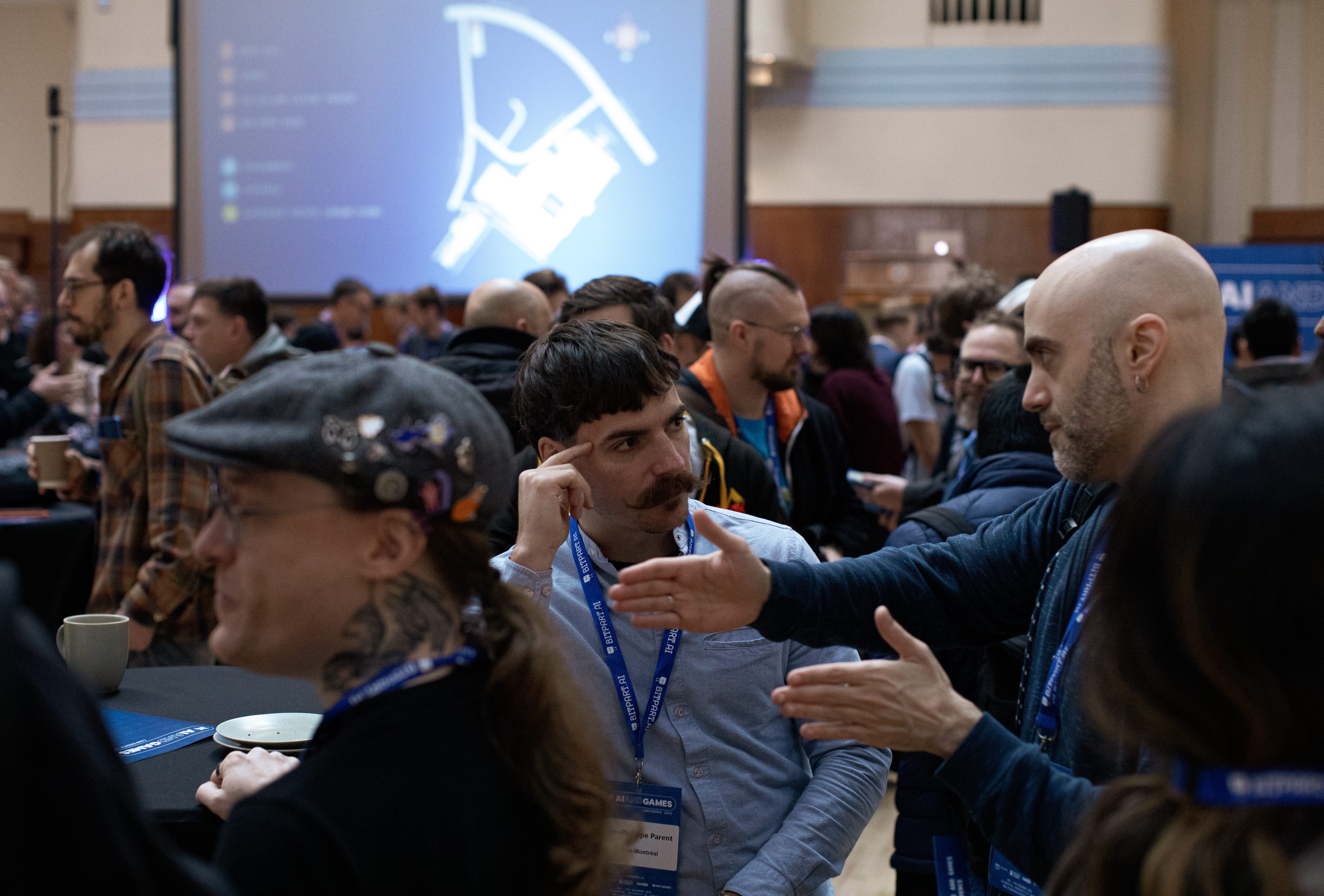
That means the fucking world to me, but it also acts as a constant reminder of the need to uphold ourselves to these standards as we continue to try and figure out how pay for all of this, and navigate a world of AI in game development that has become significantly more complex.
Plus of course we are but one community that exists. Off the top of my head I can think of:
The AI Summit crowd at GDC that Steve Rabin, Rez Graham and others have done a great job of keeping together this year what with the pivot towards the ‘Festival of Gaming’.
The Game AI Uncovered crew that Paul Roberts has cultivated thanks to his book series.
The Artificial Intelligence and Games Summer School by Julian Togelius and Georgios Yannakakis, plus David Melhart and Antonios Liapis.
Plus the academic spaces like the AIIDE, FDG, and IEEE CoG conferences.
I’d be the first to admit all of the above are more expert spaces for professionals to congregate. However by comparison, AI and Games is the largest, and loudest, of all of them. So for me, it’s all about how do we use our voice to and momentum to build bridges between these spaces, and drive more people to them when appropriate.
All of this is to say that I spend a lot of time thinking about the issues of not just fostering community that I want, but also how do we reinforce and support the Game AI community more broadly as issues come our way.
Weathering the Storms
Now more than ever it’s important that we bring this community together, ensure that we don’t just have an opportunity to exchange knowledge and ideas, but can build our own momentum and message to weather the many storms that we face as a sub-discipline in a highly volatile sector.
I’ve stated before that games, and the broader creative sector is currently being besieged by the AI industry. While there are a lot of new ideas, teams, and tech emerging that are interesting, and exploring how to use generative AI responsibly, I’ll be frank in saying the bulk of what I see is ill-conceived, stupidly expensive, and poorly-built junk. The signal-to-noise ratio when it comes to talking about artificial intelligence in the games industry is really messed up right now.
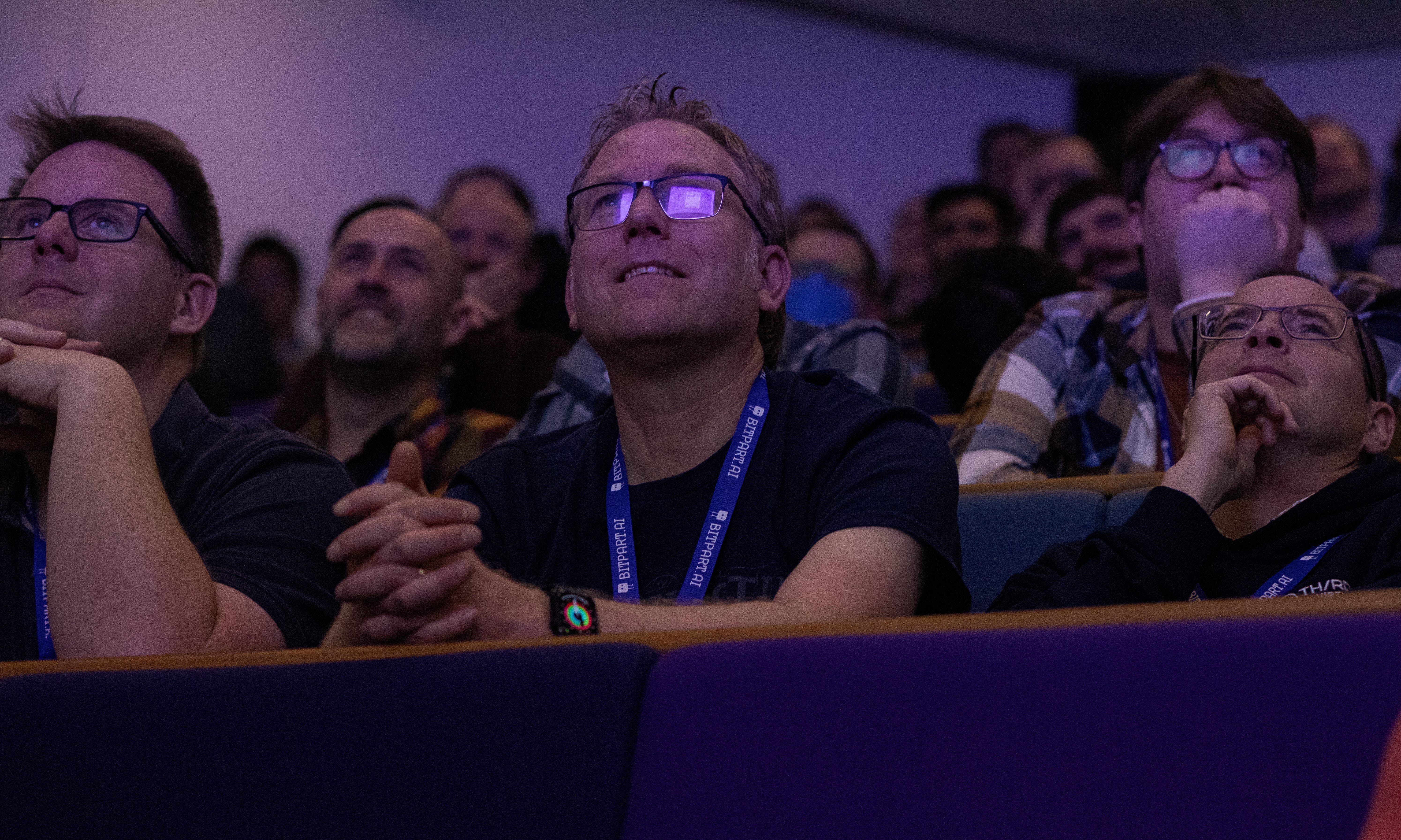
This has made the reality of being someone in the Game AI space that much harder, given as we discussed in part 1, most AI programmers in the games industry often work very little in machine learning, much less generative AI.
As I posited, there are several storms we are weathering at once right now, and we need to be mindful how we approach them both individually and collectively:
The generational shift that’s happening in the games industry as old talent phases out, and new talent struggles to get in.
An already toxic audience base whose lack of knowledge of game development is already a tremendous burden, is now amplified by the state of AI discourse.
The changes in priority as publications and venues focus on their own interests.
How political and linguistic lines draw divides between us, and the efforts we need to take to mitigate that.
A Generational Shift
One of the most critical and impactful issues the games industry as a whole is both creating, and trying to address right now is several generational shifts in talent. This is evident in a number of ways:
People who have been in the industry a long time are retiring.
People are being forced out the sector by layoffs and deciding not to come back.
Let’s not forget that between 2022 and 2025, just shy of 50,000 lost their jobs in the sector.
People coming into the industry as juniors are struggling to find jobs.
This is due to a mixture of a larger market of available talent due to layoffs, AI tools absorbing traditional junior tasks, university graduates lacking the sufficient skills for entry roles, and fewer available positions in the sector.
On average, people are staying in the industry for longer than before.
The average age of game developers has increased towards 40 years old over the past 10 years. While this is great given it addresses a known issue of talent burning out and leaving in their 30’s and 40’s, it’s compounding the existing problems for juniors.

So there’s a lot of different threads here to pick at, but the narrative I want to gleam from all of this is about the transference of knowledge and experience. Starting at the top end, the people phasing out of the industry in their 50’s worked in this sector during the real boom of the video games industry. A 21 year old junior working on a SNES or Mega Drive game in 1992 is 54 years old today. I’ve met and worked with developers who joined the sector in their late teens/early twenties sometime in the early 90s and there’s a generation of knowledge there that’s important to retain.

Now yes you run risk of chatting with them only to have old men yell at clouds, that’s an occupational hazard - plus I shouldn’t throw stones, I’m in my early 40s. But there’s a lot of expertise and experience that has been cultivated that should naturally filter down. Sure, we don’t make games like we did 30 years ago, but those little bits of genius in there that helped ship a feature are still useful to us in 2026. I speak with indie devs who tell me about the case studies/videos I’ve made on games from 20 years ago are very informative and practical for them, given they use them as means to build their own systems. Their skills and the resources available to them are often equivalent to a AA or AAA studio of 20 years ago. Take last year’s example of chatting with the team behind Trepang2 who created their very own homage to F.E.A.R. with a team of only four people.

There is always a desire even from other experts to hear about how they did it back in the day. The amount of enthusiasm and hype we had at the 2025 conference for Ian Shaw’s Dungeon Keeper post-mortem was so heart-warming. Developers who shipped games in the 2000’s cramming into the auditorium because that’s the game they were playing in college, or even at lunch breaks!
I was in high school, and Dungeon Keeper 2 was very much my jam.
Won’t Somebody Think of the Children?!?!
Now on the flip side, we also have new talent coming into the sector. We need new talent to continue to come in with new perspectives, new skills, and new ideas. We don’t just need to ensure these new developers can find likeminded individuals, but they get the mentorship and support of those that have been in this space for most of their career. As clinical as it may sound, we have to look at this whole process more abstractly as a conveyor belt on a production line. As talent leaves production, we need to be bringing in new faces to replace them, and all that experience needs to trickle back down the line. Plus we need to be looking at it not just within individual studios, but more broadly at regional, national, and international levels.
This of course sits alongside issues where juniors are struggling for entry level roles, and in an age where studios are either repeatedly in hiring freezes, replacing juniors with AI tooling, or forcing the juniors to work predominantly with AI tooling to get more out of them faster. Naturally the issues with the first two cases are highly evident: we’re not bringing new talent into the sector, and as the average age of developers continues to increase, we will create a talent crisis that will manifest in the next 10 years. But the latter issue is also a huge problem.

As any experienced developer knows, you gain so much experience from shadowing your leads. Be it working on features, having them review your code, or just sitting and chatting with them for weeks on end. The first 5-10 years of my career I spent surrounded by very smart engineers and college professors who knew their subject areas well, and the best of them know to take those juniors under their wing and mould them into future leads. I was incredibly fortunate to work with some fantastic people through grad school and then in my early career that shaped so many of the decisions and skills that drive my work today, and we need to work to enable that.
This is already a challenge for a number of reasons, but office dynamics and remote working aside, the games industry needs to consider the implications of AI-tooling entering our spaces. Given these are subsuming the roles of traditional juniors, it not only runs risk of increasing the talent gap as we don’t have new developers coming in to replace seniors as they progress, but it also means those juniors are not getting the appropriate mentorship they need and effectively exist in a lower class of professional as their expertise and career development are considered secondary to the broader need to ‘get shit done’. This is a process that media and cultural studies professors have been observing in games for some time now as we rely on an increasing range of automation courtesy of everything from procedural generation tools, to photogrammetry and ‘metahuman’ workflows. There is a risk not just that we don’t hire new talent, but that they are not giving the care and attention the deserve to thrive in the future.
I have even heard from some corners of the industry that they “don’t hire juniors”. It takes too much time and energy to do it. So it’s somebody else’s problem. They can hire them once they get a few years under their belt. But if everyone is going in the same direction, there won’t be any juniors to hire after they’ve got that initial experience. Classic short-termism.
Every time we look to promote people into senior and leadership positions, we should equally be looking at how we’re going to ensure they can eventually be replaced. As I say I feel this is an issue that is universal to all disciplines within the games industry, but given my previous points on education in Game AI back in part 2, this it feels like this is an ever bigger concern for our necks of the woods.
An Angry and Often Toxic Audience
It’s safe to say in 2026 that the term ‘Artificial Intelligence’ carries a very negative weight to it. What was once rather vague and potentially mysterious, that existed in most minds in the realm of science fiction, has since become something people are increasingly consciously aware of, and - in many instances - outright despise.
After all in 2025 the term ‘Slop’ was word of the year for both the Merriam-Webster (American English) and Macquarie (Australian English) dictionaries. Meanwhile both the Cambridge Dictionary updated to acknowledge the use of the term to refer to:
Content on the internet that is of very low quality, especially when it is created by artificial intelligence.
Meanwhile the Wikipedia article on AI slop has exploded since the first version of it was published in October of 2024 as the use of generative AI for creative outputs such as writing, images, and video has infected everything from social media to advertising, film and television production, music, books, and of course video games.
Now of course Game AI has nothing to do with this - for the most part. We’re making NPCs, combat management systems and all that jazz. 99% of Game AI uses zero machine learning whatsoever, never mind Generative AI. But it’s not like Game AI was a well understood subject matter to begin with, and now that Generative AI has become conflated to mean all of AI, it’s making what was already a difficult conversation with players all that much worse.
“Fuck AI”
Now there’s a phrase I see a lot in my day-to-day.
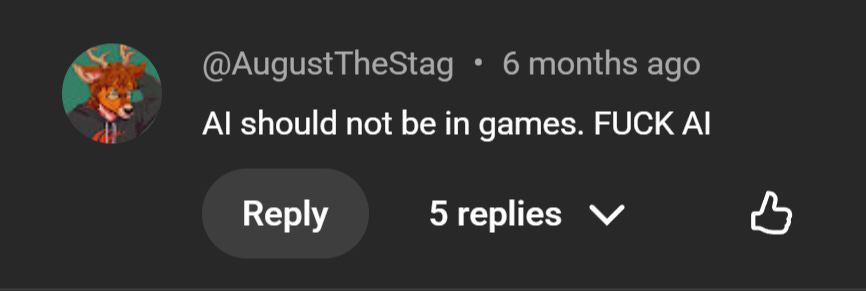
Running a company with numerous social media strands called AI and Games in 2026 means a lot of curation of our replies. While I’m not on social media all that often - given I generally loathe it - I feel it’s important as a ‘voice’ to get out there and try to challenge narratives out there, and depending on where you post, and what you’re posting about, you get a lot of ire. On average I either hide, delete, or report 10-20 comments a week on our YouTube videos from people who write very nasty messages that more often than not have very little to do with the subject matter - even more when we release any video that isn’t about classic Game AI.
I mean fortunately I’ve been publishing content on YouTube for a decade; I’ve built very thick skin. Not to mention I’m from Glasgow; some random keyboard warrior thinking they’re a wee hardman in my comment section doesn’t bother me. But it speaks to a shift that’s occurred in any and all discourse related to AI in game development. And let’s face it, the games-playing masses know very little about how games are made. It’s been an issue that the industry has created for itself only to bite them in the ass - a point I wrote up as a video a long time ago. So I do clean up our comment section in the videos a lot because I want it to show some actual meaningful discourse. Constructive criticisms are totally fine, but when we it’s just “fuck AI” or attacks on me or our guests than I draw the line.
Heck the new trend on the YouTube channel is having people tell me I should change the name of the channel so as to get more views, because ‘calling NPC stuff AI isn’t going to help your reach’, and while they might have a point, it’s not something I’m going to act upon, because making concessions like this is detrimental as a whole.
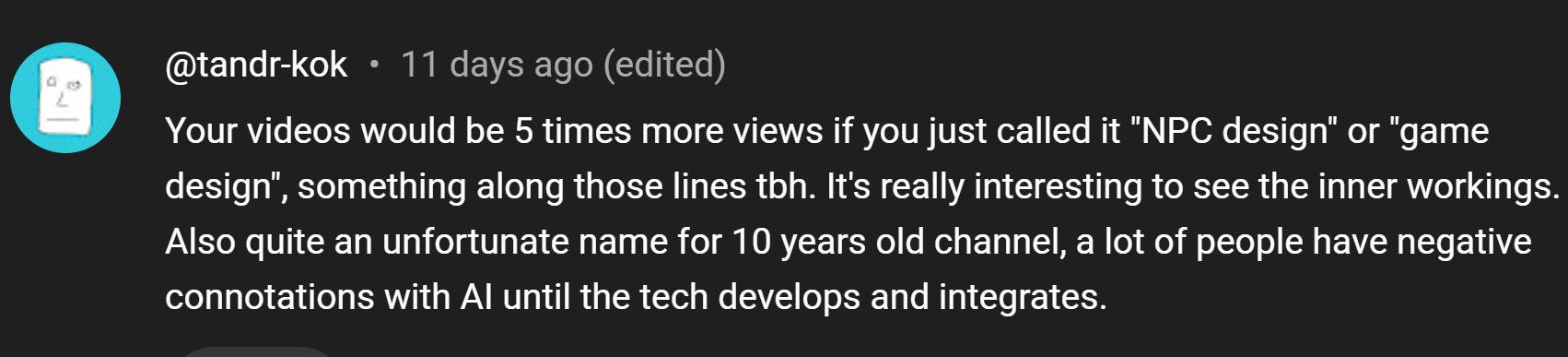
Now yes, all of this is having an impact on the YouTube side of things. Our viewing numbers have plateaued the past 2 years, and subscriber growth has reduced drastically (percentage growth year-on-year is higher in the newsletter than the YouTube channel). But I don’t believe in making drastic change to suit these trends. I’d rather stand by my own principles and continue to do what we do because I know in the broader industry we’re respected for this output.
So while I’m not terribly worried about the YouTube side of things - I mean it’s never been a sustainable channel to run as a full-time job even when it was popular - I do worry about the broader implications the things we’re seeing are having elsewhere. After all, people are quick to conflate that any discussion about AI in game development is now Generative AI. Or that features implemented in games that exhibit traits of intelligence and procedural construction are now Generative AI.
It’s bad enough that - per my comments in part I - that quite often we’re now being told to re-invent Game AI wheels using Generative AI when we really don’t need to, but now you have a player base primed to assume any meaningful development in Game AI is now tarred with the slop brush. What if a new AAA game comes along and starts crafting really cool and intelligent NPCs? Are we going to have people breathing down our neck assuming we used GPT to do it? Hang on, the goalkeepers in EA Sports FC 26 use machine learning? Does that mean gamedevs are being lazy now?

Plus, as I stated in a previous entry I still think there is value in trying to figure out how to use small-scale, finely-tuned ML models to help address very specific Game AI problems, and some of those ML models could very well be generative in nature. But heaven forbid we ever disclose that publicly if you don’t want people jumping into your social media feeds or Steam reviews. Episodes we’ve made this past year such as MLMove and Snowcap, where I’m looking at what I think are interesting attempts to utilise ML and Generative AI in game development, have had all sorts of bile in the comments that I had to clean them up quite a bit - plus we got shit for it in our social media posts. Now clearly the people shouting below the line are not actually watching or reading the work, given if they did, they’d know none of the issues people have with Generative AI as a whole are evident in these projects - and credit to the folks in our audience who actually responded to some of these comments and called them out on this, thank you all.
But it doesn’t matter. The kneejerk reaction is just to shout online.

If anything it reinforces to me that as a sector we need to continue to be vocal. To push back against the narrative set by the Generative AI Industry that has set about commercialising the very technology people broadly despise. I wrote a op/ed piece on this for GamesIndustry.biz which was released the very same week that DLSS5 blew up in Nvidia’s face, only helping to prove my point. The signal-to-noise ratio in discussing AI in game development is overwhelming skewed towards the noise. We made to have more signal out there to combat it.

It seems like the language needed to engage with players is going to be a major concern if we’re going to try and keep communicating the efforts taken here. I’ve noticed somewhat anecdotally that ‘Machine Learning’ is now often being used to describe any ML-based approach, including Generative AI, that isn’t considered icky. This cropped up a lot in recent weeks what with the DLSS5 debacle, where I see people talking about how old DLSS is just an example of Machine Learning being useful for different parts of games, including upscaling. Meanwhile DLSS5 is now just Generative AI slop - despite the fact that any and all forms of DLSS - and AI upscaling as a whole - are Generative AI by virtue of their function.
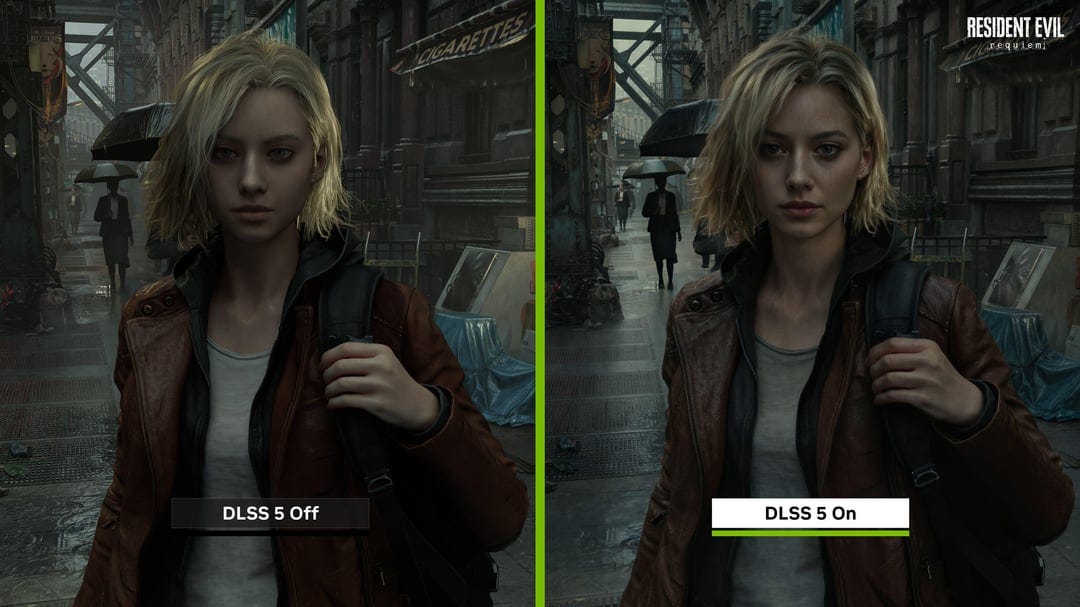
I have wondered in the past year how much Nvidia dodged a bullet in their branding and messaging in that they commercialised DLSS long before Generative AI became mainstream. It seems like only now are people catching on to what that tech really does.
But of course this is just the conversation between the developer and the player, which has never been all that fun anyway, and in many larger studios isn’t an issue for us day-today. But this same thing is happening right across the games industry.
“I Work in AI, But Not Like That”
How many of you who work in game AI and adjacent fields have had to defend your job title in recent years? Now that’s not even an issue of engaging with the general public or our players, this is an issue happening within the industry itself. The term ‘AI’ has become so loaded within the industry as the ongoing anxiety surrounding Generative AI’s push into the industry means we’re having to re-affirm to our colleagues in the sector what it is we actually do.
All of this reinforces the need for us to fight our corner, and continue to educate people on what this stuff really does. Sure, we won’t change everyone’s minds - especially those in trapped in social media bubbles - but much like our efforts in education it’s important to hold our ground and continue to talk about the work that’s happening in this corner of the sector so that those wanting to learn more find that material out there to consume.
Changes in Priority
So thus far in this edition we’ve got the challenges of bringing in and retaining our talent, and then trying to defend against the anxiety within the industry as to our work as well as the general noise coming from social media. But we still have our own little corners within the sector within which to engage and collaborate? Sure, we have meetups, Discord servers, mailing lists (that’s still a thing right?), plus of course book publications, and events. But these last two are for me a larger concern, given we’re seeing the trends surrounding AI that are also affecting the likes of education potentially impact these avenues for dissemination and networking.
As I discussed in part two, the shifting trends in what is considered in vogue in the world of AI means we have to keep fighting to justify what Game AI is and why it deserves its own space. It’s a challenge we face in our editorial for the AI and Games Conference because while we recognise that machine learning is a useful tool in production, and there are 101 people wanting to get on stage to talk about Generative AI, we still need and want to curate a space for the Game AI community that most of our founding team built their careers in.
Now we’re something of an outlier: we’re a small organisation built by people who work in this space, who know this space, and want to serve the community. The rest of the sector doesn’t really think about Game AI in the same way we do, because most of them have never worked in it!
So what happens when they decide to follow the AI hype? What impact does this have on those community spaces? I mean they are few and far between as it is, and all of this is very much a veiled description of GDC’s 2026 “Festival of Gaming”. An event that emerged courtesy of a panic in declining numbers and marketing spend across 2024 and 2025, combined with the impending termination of the (highly beneficial) deal that Informa has with running the event at the Moscone centre in San Francisco.
While my point extends far beyond GDC, this past year is a shining example of what happens when the bigger players who manage community spaces have a change of heart…
How the ‘Festival of Gaming’ Came to Be
Contrary to the narrative bouncing around the internet that states GDC dropped 10,000 attendees in a year, it actually dropped around 5,000 each of the last two consecutive years. You may note that in 2025 they stated they had “nearly 30,000 registered attendees” versus the 30,000 attendees the year before. The subtle messaging in 2025 was to obscure the fact that a lot of speakers, exhibitors, and regular attendees cancelled in the closing months courtesy of the changes happening at border control at the US. When I enquired about this particular choice of words at the GDC AI Summit post-mortem in the summer of 2025, it was explained to me the number was much closer to 25,000.
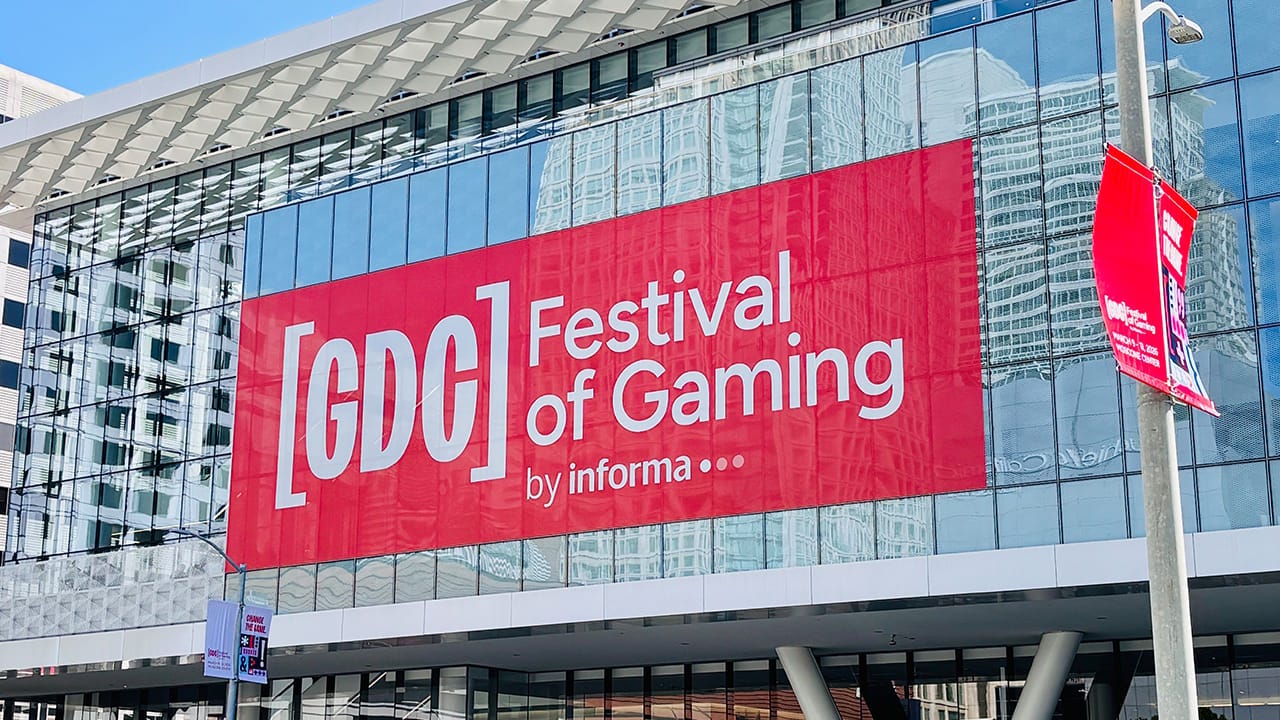
Now I raise this not to try and soften the blow GDC has had this year in the attendance data - frankly they should have been more honest about it because there was no way it was going to go up this year. Rather, I highlight it because it gives context as to why the whole “Festival of Gaming” pivot even happened. They brought in consultants in early 2025 to examine the data they had from the event, ranging from ticket purchases to consumer spend and overall footfall, and the thing that was made clear was that people value the GDC Summits; the first two days of the week where people converged on topics focussed on specific disciplines.
The data highlighted that a not-so-insignificant proportion of attendees bought the ‘Summit pass’, which entitled you to access the two days of summit talks, the expo floor and some of the other talks and roundtables that happen throughout the ‘core’ conference from Wednesday to Friday. The summit pass was also significantly cheaper than the ‘Core’ pass - around $1,950 for Core versus £1300 for Summits - and this meant three key pieces of data:
Attendees were paying for the ‘cheaper’ pass that delivers value.
A larger proportion of attendees attended the Summit talks versus Core conference talks.
Attendance would trail off towards the end of the week because a lot of people only really attended for the Summits and would leave before the end of the event.
So what this tells me, is that the Summits were delivering value for the audience in a way that Core does not - and I’ll be honest outside of the AI roundtables and some of the main stage talks I seldom attended the main conference given there were too many sponsored sessions and stuff that just didn’t interest me. It also highlights to me what the value of the Summits are to attendees:
Programmes curated by subject experts for subject experts.
A place for likeminded individuals to attend, connect, and network.
So it’s clear the Summits are of value to attendees, and to GDC given people are spending money on the passes to attend. So perhaps there’s a way to utilise this in a way that works for Informa? Get people to attend for the summits, but keep them around throughout the week? Maybe even reschedule the event so that the summits are a week-long affair with different ones running on different days? Run the summits in the back half of the week rather than the start?
What was the conclusion they reached? Remove the Summits.
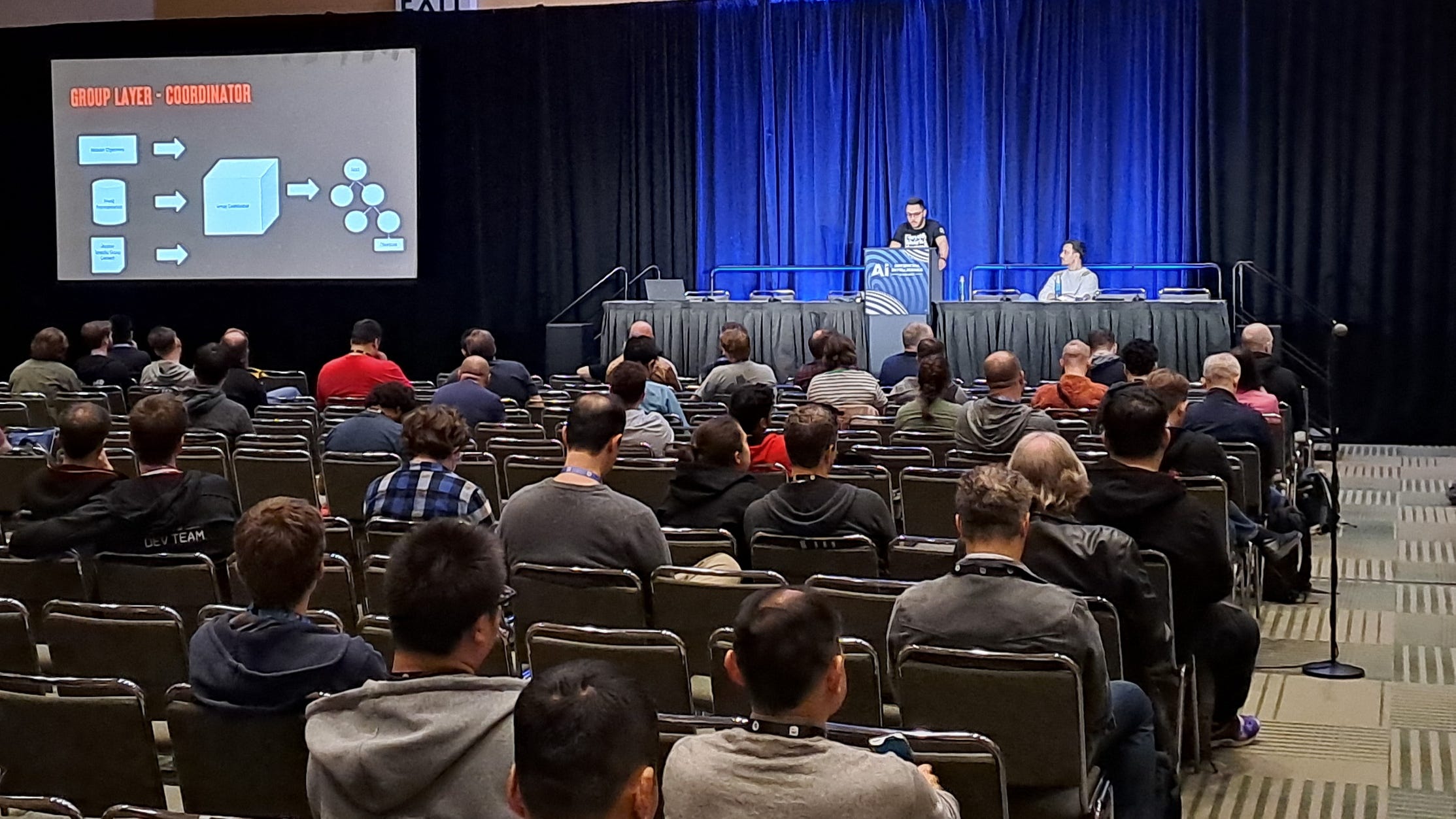
The Death of GDC’s Community Spaces is a Warning
While this segment is about the broader impact of AI trends influencing our decisions making, I refer to the GDC situation over the past two years given it is emblematic of this very problem. As AI hype continues to trend, GDC has sought to capitalise on it. Often with a larger number of sponsored talks on the subject that - based on my time attending a handful across 2023 and 2024 - are certainly not the value for money Informa thinks they are.
Meanwhile back when the Summits still suited them, they tried to force more and more Generative AI into the AI Summit in 2023 and 2024, including a Roblox talk in 2023 that at the time none of us really wanted but the organisers pushed to be added. Plus in 2024 there was a Google talk advertised as an AI Summit talk when it wasn’t part of our programme - in fact it was double booked with another AI Summit talk, and in a different room from where our community got together.
Plus, there was GDC’s mini ‘AI Summit’ as part of ‘The AI Summit New York’ (an event ran by GDC’s owners Informa) in 2024, where they were reaching out to previous speakers to present, only for me to get emails from said speakers asking if this was legit? Or if we had any information because it was poorly communicated. I then had to ask GDC what was going on, because the messaging was confusing. Admittedly, they’re free to do that if they want, but for the community surrounding the summit when they see ‘the AI Summit’, they think the advisory board will be involved. So being left in the dark, even if there was no intention to have us involved, struck me as rather disrespectful.
On top of all this, in 2024 I spent two weeks in a daily email correspondence with some of the GDC organisers who simply assumed the AI Summit was a perfect place for all of the Generative AI content to go. After all, if this summit was about AI, then surely it made sense to start pushing for Generative AI content to just go in there? This lead to a lengthy correspondence in which I had to explain to GDC what the AI Summit is actually about, to try and prevent them burning it all down.
Admittedly the name of the summit was out of date, given when it was founded some 15 years ago, ‘AI’ for games simply meant Game AI - NPCs, gameplay systems, and virtually none of it used Machine Learning. Now of course we had a Machine Learning summit that muddied those waters a little, in that while both the AI and ML summits had clear agendas and goals, the purpose to anyone outside of the field might prove confusing based solely on their names.
So yeah, if you wondered why in 2024 GDC suddenly renamed it to the ‘Game AI Summit’, that was my doing. I convinced them to do that to reinforce the need to our community we still had a dedicated space at this event despite the ever-increasing hype surrounding AI in the industry.
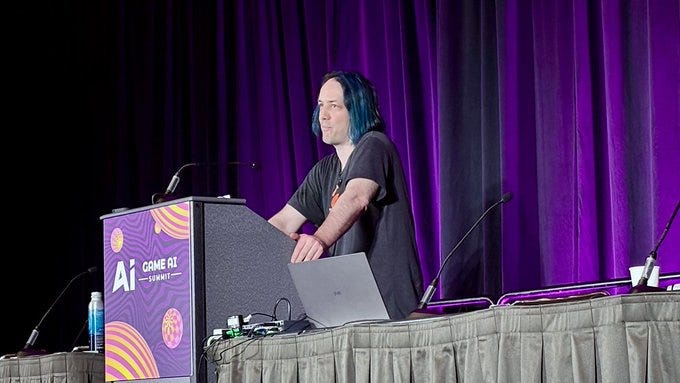
In fact I even offered to help them kickstart a Generative AI Summit in 2025 if need be, just to ensure we preserve the Game AI Summit for what it was. Only for them to remove the summits from the format a year later.
I have since spoken to a bunch of people who attended GDC 2026 and while disappointed about the Summits not existing, they could still get by given they knew other community members were in attendance. But me, I’m still angry about it.
These Summits made sense as dedicated community spaces. Whether you were a seasoned veteran of the field, or someone new to the space, for two days of GDC you knew where your peers were. Where likeminded individuals would attend. That’s a great place for people to network, to meet respected voices in the field, and foster a sense of community. That’s a responsibility that the advisory board took very seriously. We curated the talks, we mentored the speakers, we ensured they received an introduction and applause as they took the stage, we helped them with tech issues, and moderated their QnA. All to make sure that when someone gets up and presents in that hall that it’s a celebration of them and their work.
The Game AI Summit was the longest-serving community space that this field had, and for all its problems, I know how important it was to a lot of people for them to get up there and present to that audience.
Sure, there was still a Game AI presence at GDC this year, but like every other community who lost their summit, the fundamental lack of a dedicated space for a fixed period of time was detrimental for those communities. Over the past six months I have spoken with people involved in many of the other summits at GDC, and none of them are happy about the decisions being made - and in some cases led to them deciding not to attend this year.
Now there’s a chance that Informa changes their mind after they saw another decline in attendance numbers this year and bring the Summits back. But the issue here is two fold:
It highlights how all too quickly an institution that has come to hold some sway or impact in our field can be brought down despite our best efforts.
All of this is not just a reflection on how priorities can change and impact the communities that we cultivate, but not necessarily control, but also how broader political factors can also prove detrimental.
The Political and Linguistic Lines
GDC in the past two years is a great example of socio-economic and geo-political factors impact the game development community. After all attending GDC is an expensive proposition, and frankly it has only increased in cost the past couple of years as flights, accommodation and other expenses continue to increase. But also people are concerned about entering the United States as a result of its border control and immigration policies. All of this culminating in a situation that attendance is down by a third in the space of two years.
But this is not an issue that is unique to GDC, nor is it even the first time that this criticism has been held aloft against the event. GDC has for as long as I can remember had a negative reputation given the significant cost to attend, and the US not being an easy country for people to enter if they don’t arrive from very specific corners of the world.
Of course I’m Scottish - so technically British (ugh) - and that opens doors for me in ways that others simply lack (and I am highly aware of it), but then our own border control has proven problematic in recent years.
“The British? Problematic as a result of socio-economic and geo-political policy?” I hear you say. I know, what a surprise…
We’ve dealt with this first-hand with Brexit impacting travel for people to enter the UK for the AI and Games Conference. We provide support where we can, notably in letters of support for visa entry for speakers and partner delegates. But we have people who want to attend our event in London and can’t given they won’t be granted the visa they need to enter the country for even a couple of days - and as event organisers we cannot support for attendees given there’s no legal basis on which we could argue why we should vouch for them (especially if we don’t know them).
All of this reinforces the need for us to branch out and try and run events in other spaces. To try and find ways to bring ourselves together. By providing more options it at least helps foster community at smaller levels and then we can work to build the bridges internationally.
I mean full disclosure we’ve been blown away by the level of enthusiasm for our conference. We hoped in 2024 to maybe get 100-150 people together, and by end of 2025 we had recorded attendance of just shy of 400. Our estimates in attendance data for 2025 suggest that we’re seeing increasing numbers of attendees from Europe and North America. So now we have the two (great) problems of ensuring we have a space big enough, but also try to ensure we don’t grow to a point where we become part of the problem! I look forward to somebody complaining about me in the same way that I have moaned about GDC for much of this piece.
I am curious how things will play out for events in Europe this year. Whether it be Develop, Devcom/Gamescom, and even our own AI and Games Conference. The sentiment is clear that people are avoiding GDC and US-related events. Does this translate into increased attendance at events over here? I wouldn’t be surprised if most major UK and EU events record increased attendance this year.
I do feel there is a space for more Game AI events, and having opportunities for our community to converge a couple of times a year would be great. They can exist in various sizes, cater to specific disciplines, and don’t need to be huge developer conferences to have value. Just having something helps support pockets of our community in the long run is always great - like all the regional indie game dev events I have attended over the years. As I mentioned at the top, I try to use AI and Games to filter people into other relevant communities. I am big on building bridges versus burning them. It’s why I go speaking at industry events all over the world, because we need to be bringing ourselves together more readily.
Don’t Forget Linguistic/Cultural Barriers Too
Plus it’s worth mentioning as I begin to bring this to a close, that there are also the linguistic barriers as well. We’re still exist in a world where game development practices, cultures, and success stories are seldom shared beyond the global east/west divide.
We still exist in an age where there is a lot of mystery about how games made in China, South Korea, and Japan. Yes part of this is the aforementioned political aspects, but there are also linguistic and cultural barriers. It’s not common for ‘western’ studios to present at say a Japanese game developer event or vice versa. In all the years I’ve been involved in disseminating knowledge about Game AI, it’s incredibly rare to find studios from Japan share their work with European and American audiences. We’ve never had Capcom come and present at GDC about the AI of Resident Evil or Monster Hunter. The only studio I can think of who does this with any sort of regular cadence in Square Enix, and that’s largely courtesy of Youichiro Miyake being a strong advocate for building bridges and sharing knowledge.
Heck, did you know that back in 2019 that Miyake-san wrote an entire book just about the Game AI in Final Fantasy XV? A complete, 250-page book on the subject? Miyake-san has published several books not just on specific games, but anthologies designed to communicate to the broader Japanese game-playing community on how Game AI works in some of the most beloved games made by the publisher.


I have contemplated more than once to try and crowdfund getting these translated and either re-published in English or turn them into content on our site: I even spoke with Miyake-san about this more than once in recent years and he was up for it. Like, this is a treasure trove of material locked off from us. And I suspect this is just the tip of the iceberg.
I mean first of all, if that’s something you’re interested in, let me know in the Discord or in the comments. Goal State will launch later this year and I’d be up for crowdfunding some more projects, and I would love to find a way to bring this information to the west somehow.
But more importantly, it once again highlights that we need to find ways to build bridges between different corners of the game development community. I mean did you know that a lot of mobile games coming out of China and South Korea almost exclusively use Machine Learning now for Game AI? I mean I do because this is the stuff I spend hours of my day researching (ha, nerd). But what are they learning over there that we could benefit from (and vice versa)? What is it about their games, their development cultures and practices that lead to different philosophies in how they build Game AI? I’d love for us to work to build those connections even further if we could.
No, this doesn’t mean we’re planning to run like AI and Games Conference: Tokyo or something. God that sounds stressful, but also, cool?
Facing the Challenge
So I think, having reached this point, I’ve got most of the big issues to mind off my chest. So I need to start wrapping this up, and I want to focus on my suggestions on how we move forward.
I think there’s a lot we can all do at various levels to address this. Some of them major, others are minor. But the key thing is I believe this is a community endeavour. We all need to take a little bit of responsibility for this, and work together to help support.
Some Suggestions for Action
So what can we do? I have some thoughts on this at varying levels of depth and complexity. But I wanted to list as many as I could think of. Some of these range from the simple to the complicated, and I appreciate some of these are very difficult to achieve. But if I didn’t think they were valuable, I wouldn’t raise them!
I’ve grouped them around roles and functions in the sector to try and give it some direction:
Developers at Games Studios
I appreciate that many of these are a challenge depending on how your studios operate and communication guidelines that are in place. But
Share Your Work: Write blog posts, submit talks or book chapters, do social media threads, simply work to encourage discourse about the development of the tech you’ve made. Regardless of whether you’re indie or AAA, talk about what you did. What inspired you? What did you play/see/read that drove this implementation?
Share Your Failures: We’re too quick to talk about when things went right. It’s important we continue to discuss when things went wrong. We often learn the best through failure. Did you try something new that didn’t work? What issues in Game AI development have plagued your career?
If Not Your Work, Share Your Experience: We’re often quick to focus solely on the game we shipped, and not the experience that surrounds it. Can you talk about problems you’ve solved in commercial projects without discussing the game itself?
Be Curious of Academic Works: There is a wealth of research in both Game AI and AI for games that is published on an annual basis that isn’t really read outside of that ecosystem. Try and find niches that interest you. Perhaps attend a conference or similar event if you can? Engage with academic researchers who will be more than happy to talk to you about their research - and even explain the papers if they’re impenetrable!
Try and Encourage Academic R&D: Where it makes sense, try and engage with researchers about the work they have done and how it can impact a specific niche or aspect of your work. There are a handful of academics out there who participate on the regular - and I’m essentially a lapsed researcher who consults for games studios.
Sponsor and Support Endeavours: Naturally for many of the folks at the coalface, they’re not in charge of the budgets. But consider how to work to support education providers and initiatives, academic partnerships, event sponsorships etc. There is budget there at larger companies that can be put to good use to benefit everyone.
Academic Researchers and Students
Get Yourself Out There: We know how important it is to get out there and publish, but if you find there are other avenues you can take, then do so. Attend industry events ranging from the big ones to the little ones wherever your budget can afford. Bridging the divide where can on both sides is always a win for both parties.
Publish Outside Academic Lines: Much like the previous point on sharing your work, academic researchers are far too prone to only writing in academia about their work. Hence outside of that space you’re not known. Write blogs about your research. Talk about the journey. Share social media threads about your papers and what they mean.
Be Aware of What the Industry Problems Are: I don’t mean this as a dig, but far too often academic research has a rather naïve take on what the problems are in day-to-day industry (I’ve been guilty of this in the past). What are the things developers are still struggling with? These can sometimes lead to new avenues for your research.
Consider More Industry Collaboration: Now this is admittedly a lot easier said than done. But anywhere we can find that brings these often disparate corners together can be of value. This doesn’t need to be massive research projects with huge budgets. But having discussions about the validity of research in context of industry work is useful. Though note I say this only in the situations where this makes the most sense. After all, not all research is intended for real-world application - even if shareholders often insist that it is.
Games Press
A quick one for all of my friends out there in the games press. You seem to have forgotten Game AI is a thing.
Don’t Just Regurgitate the Headlines: Get out there and find people who can give you a comment on these issues. Or in the worst case scour the internet for a spicy take on BlueSky you can share alongside it.
Pay Attention to What We’re Really Doing Here: 99% of the discourse around AI right now in games is not what most AI practitioners in games are actually doing. There continues to be innovation happening out there and you’re often missing out on fun and interesting stories.
Continue to Take An Interest in Game AI: It’s not often you hear a game get plaudits for its NPC AI, but if you do think it’s good, or even if it has issue, be vocal about it and talk about it if and where you can.
Devs/Researchers at Local and Regional Levels:
Not everything needs to happen at global and international level…
Host and Attend Meet-ups: The latter is easier than the former, that much I can attest. But fostering community is valuable. You can do this at your local college, or as part of an indie space. Simply getting together to discuss what you do and how you do it can be helpful.
Share Your Learning Experience: Write that blog/video/talk about attending GDC or the AI and Games Conference. Summarise book chapters or talks that excited you. Think about how you providing a 10-minute long insight in sharing what you learned can help others.
Communicate and Reach Out: Speak to your peers, and reach out to others in the space to see if they can you in any way they can. I’ve presented virtual talks and recorded introductions for small Game AI-focussed events all over the world. For those with a little bit of clout, remember sometimes you reposting the work of others and sharing a message can be a huge benefit to them.
Better Knowledge at Representation and Governance Level: Far too often I have to correct people in positions of authority all over the world about what Game AI is, and how current trends in AI are a disservice to this corner of the sector. This needs to be reinforced wherever we can and why this isn’t going to change.
Archival and Resources
A little something for everyone to be thinking about. We’re losing knowledge and we should work to archive it as best we can.
Consider Archive.org: If you don’t fancy maintaining a webpage of old materials, perhaps put it up on Archive.org and share social media posts with the links.
One day, when I’ve finally had enough, I am preparing for my endgame where I upload everything I have to Archive.org. All the videos, the scripts, the research notes, all of it. I have TB of data that I plan to just release into the wild one day.
We Need to Think About Collective Ownership: A recurring theme throughout this piece has been that we’re often let down by the institutions that support us. What happens when the next event organiser changes their minds? When the current book publishers give up on us? When the next figurehead of the community disappears after being found to be problematic? We need to be thinking more broadly as a community on how to support our own endeavours, and not just rely on larger organisations and individual efforts.
And yes, I am also referring to myself in this. Not only will I not be doing this forever, but also I need to be held to account for what I’m doing in this space.
TL;DR
Make Some Noise
Learn From One Another
This is a Collective Effort
Take the Initiative
Stand Up and Be Counted
Get Out There, Be Nice, Have Fun
What We’re Doing
As I bring this series to a close, I wanted to talk about what we’re doing about all of this. In the same year that this sense of unease fell over me, that the broader questions over how and where Game AI is going really took hold, I also come to recognise that I have some influence over this.
In 2024 I decided it was time to try and fight back, and find some ways to make a positive impact.
I launched this here weekly newsletter - which now has thousands of readers each week from across the games industry.
We successfully crowdfunded the first of my online courses under the Goal State brand. I am currently in the middle of writing, recording, and editing the final product, and we’re on track for a release in 2026.
And lastly, my friends and I formed our non-profit event company Game AI Events CIC, and that’s how the AI and Games Conference was born.
I am publishing this final piece of the essay while I am knee-deep in preparations as we seek to announce the 2026 edition of our conference. It’s a huge amount of work. It’s incredibly stressful to put something like this together. Plus I won’t lie, I am not getting rich of the back of this. I mean I’m doing okay, but like… AI and Games quite often only has six to nine months of runway on a regular basis. So hey, provided the money is coming in, and we can keep the lights on, we will continue to do what we’re doing as best as we can!
So yeah, I will continue to be annoying to ask for your support. Because the things that we do to help archive and communicate Game AI - including the conference - is the things that pay us the least!
But regardless, I am so proud of our team across both AI and Games and Game AI Events CIC and their commitment. I am grateful to everyone we work with in our sponsors and speakers who give their time, energy and resource to help us do this. We have some pretty grand ambitions for the AI and Games Conference, but that’s going to take us a bit more time to achieve it. However if we can pull of what we have envisioned for the next 2-3 years, that would be pretty amazing stuff.
Now more than ever I am 100% committed to trying to make this work: conferences, courses, case studies, newsletters, content, etc. Not just because I believe in it. Not just because I feel we need to address these issues, but also that failure to maintain momentum now will be detrimental for everyone. As I’ve spent the past three articles expressing, I feel the situation for us is pretty dire, and I’d rather not look back and regret not trying to do something about it when I had the chance.
Naturally if you have opinions on what we’re doing I’m welcome to discuss them in the comments, or in the Discord. Tempting fate with that one I know…
Ultimately, in an era where our YouTube numbers are dwindling, it would be all too easy to just give up. I mean I’ve been doing this for more than 11 years now. I’ve done my time. But if anything it highlights to me that the problem is evergreen, it’s just the parameters have changed, and so has our strategy. AI and Games will continue to work to be the voice on Game AI for newcomers and experts that you can trust, and I look forward to working with all of you to keep fighting that fight.
Stay safe, take care, and I’ll be back.
Just call it gameplay programming maybe? That includes NPCs, bots, etc.
Honestly, the term AI always felt like a pretentious choice. It was really bad marketing from the beginning, and in my opinion is partially responsible for it being misunderstood all this time. Now it's just worse...
In the context of games, we're normally talking about algorithms, math, and creating some simple models to get a desired behavior.
I say just call it gameplay programming.