

What Does the EU's AI Transparency Rules Mean for Games | 06/08/26
Plus Xbox still on fire, EA now a Saudi soft power asset, and Stellar Blade's K-Slop?


Hello all and welcome to AI and Games! We’re currently knee-deep in prep for what is going to be a very busy couple of days for us in Cologne at Gamescom. Plus what’s going to be an equally hectic September when we get back. I mean I can’t complain, we’re bringing in the money and paying the bills, but boy it all really happens in Q3 doesn’t it?
This week I figured why not spend the newsletter talking about the law, again. The EU AI Act saw one of its final major steps towards full implementation go live this week, and there’s a tiny part of it all about transparency of AI systems. Thus far all the legal guidance suggests it’s not an issue, but I worry that’s because a lot of the broader legal ecosystem doesn’t really understand AI in games. Let’s dig into it!
Follow AI and Games on: BlueSky | YouTube | LinkedIn | TikTok
Announcements
Our final batch of Gamescom Dev talk announcements plus some AI and Games Conference updates!
More Gamescom Dev 2026 Talks
We have our final batch of talks to announce for the AI tracks at Gamescom Dev which is in less than two weeks time, and we have a Tencent double bill in this line-up.
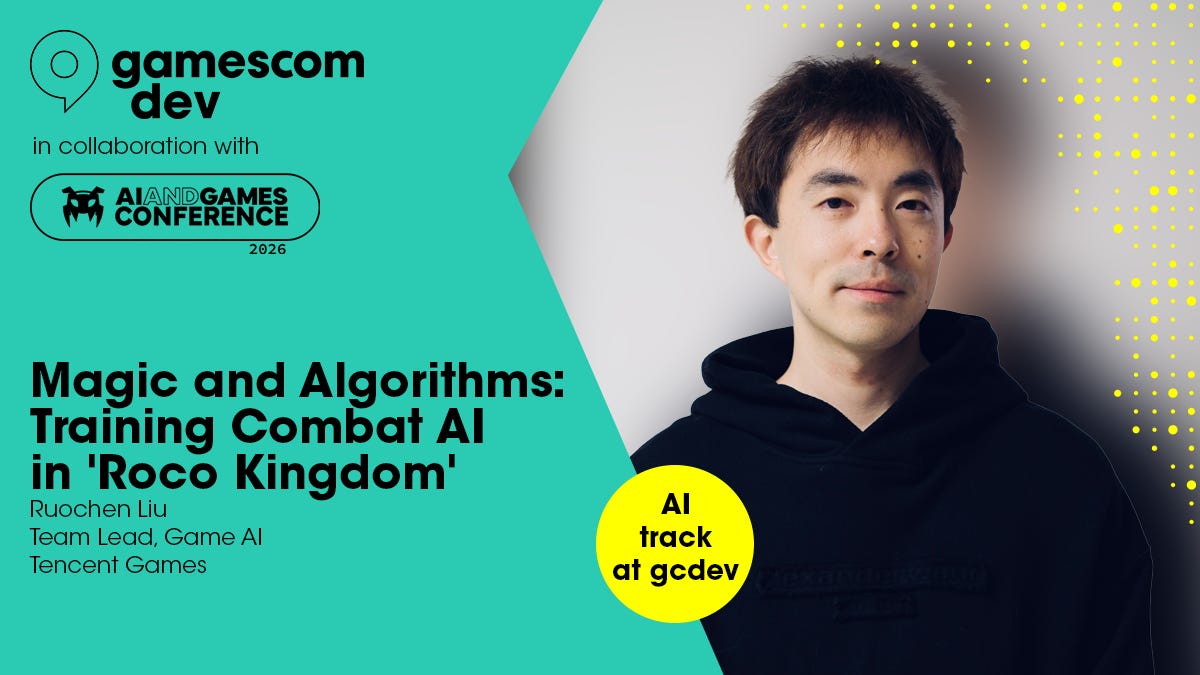
Magic and Algorithms: Training Combat AI in ‘Roco Kingdom’
Ruochen Liu / Tencent Games
Roco Kingdom is one of the most popular games in Tencent’s homeland of China, and it requires a stable and robust framework for complex turn-based combat to serve the tens of millions of active players. To that end we welcome Ruochen Liu who gives us a breakdown of the deep reinforcement learning and LLM-powered pipeline the studio has adopted, to ensure the billions of matches that run inside the game continue to transpire smoothly.
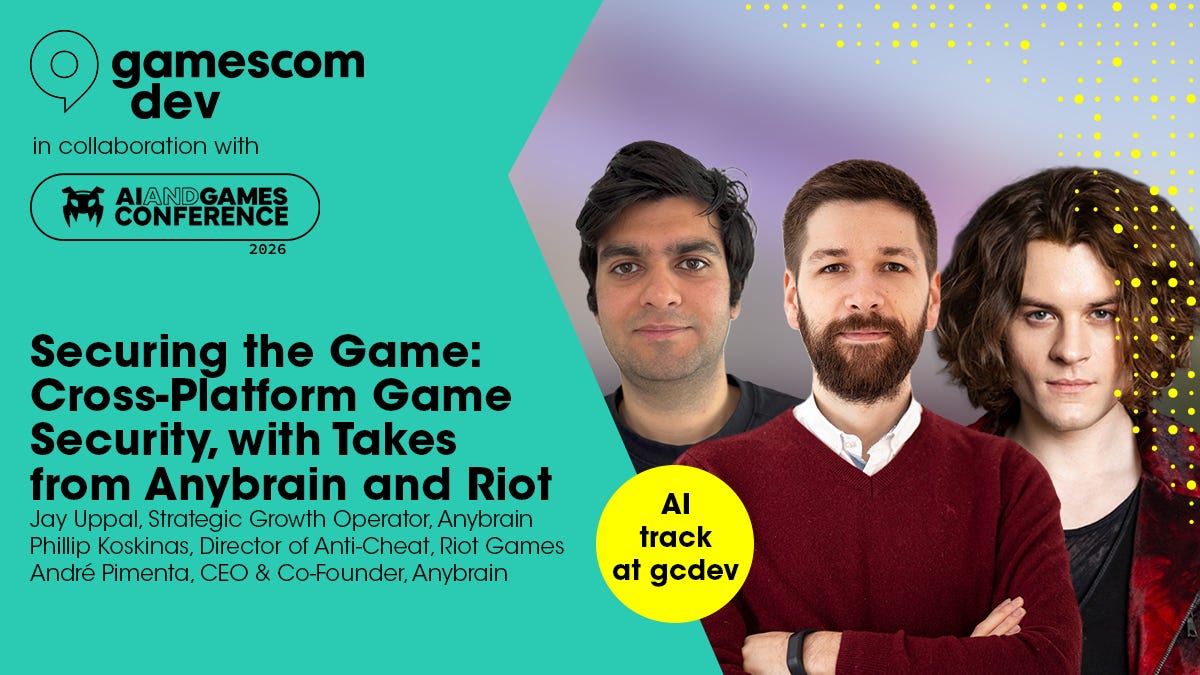
Securing the Game: Cross-Platform Game Security, with Takes from Anybrain and Riot
Phillip Koskinas / Riot Games, Jay Uppal & André Pimenta / Anybrain
As AI tools move into the hands of developers, so too do they become accessible to players. This has accelerated the arms race in cheat detection and security. This talk gives an overview of how AI-assisted tooling by cheaters is creating new challenges for both PC and console titles, and how companies such as Anybrain and Riot are rising to address it.
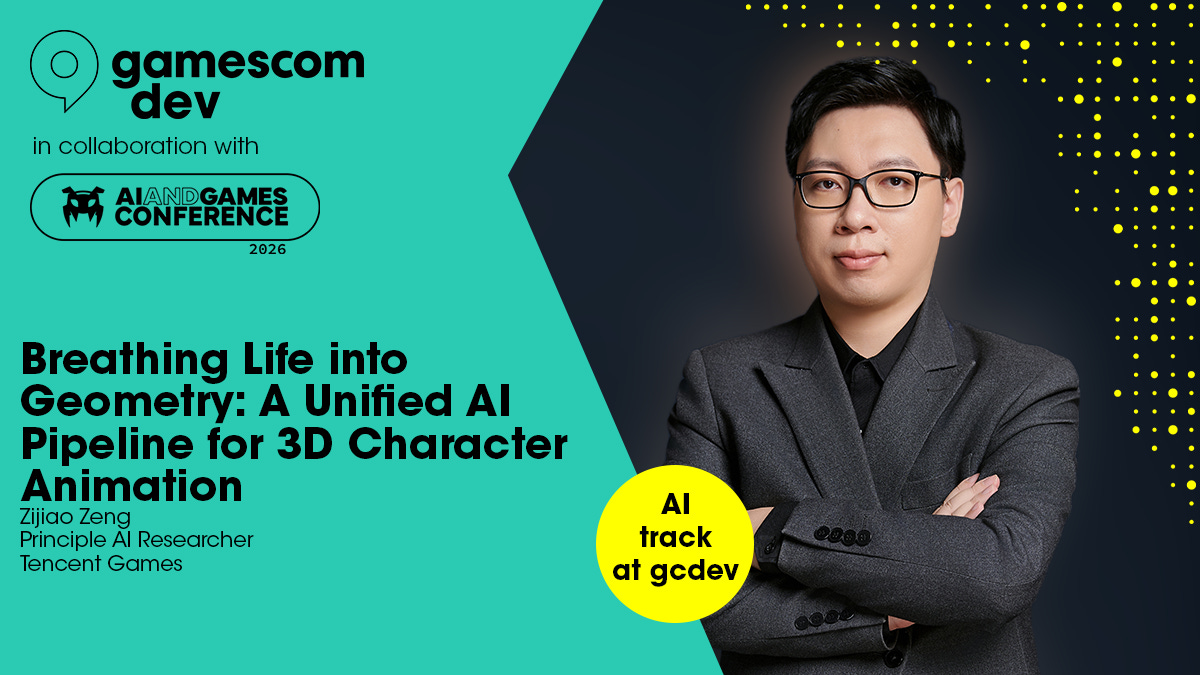
Breathing Life into Geometry: A Unified AI Pipeline for 3D Character Animation
Zijao Zeng / Tencent Games
We’ve discussed at length in this newsletter about how enthusiastically studios in Asian territories have embraced AI technologies across production. However, we are often left wondering what exactly is happening in this space and the extent to which AI tools are impacing traditional workflows. We have Zijao Zeng from Tencent present to highlight the work they’re exploring in a Generative AI pipeline for 3D character animation, including automatic character rigging, skinning of character models, and multi-modal systems for motion generation.
AI and Games Conference 2026
Some quick notes on this year’s event…
Early Bird Sales Have Ended: A quick note to say that early bird tickets sales have now ended. Don’t worry if you’re planning on attending as regular tickets went live as soon as early bird sales ended for each category (we sold out for both indie and studio devs prior to deadline).
Talk Submissions Are Closed: We’ve received a staggering number of entries this year - breaking not just our own records, but also we’re now exceeding the likes of both GDC’s Game AI Summit and Gamescom Dev’s AI-themed submission counts. This is of course great in that we’re excited by the enthusiasm, but it’s also not so great as we need to sit and review them all!
Our goal is to have decision emails out by the end of the month. Bear with us as we work our way through it as the review team sits and scores all the submissions and makes a decision on where all of this goes.
Sponsorship Opportunities Still Available: We’re grateful to our wonderful bunch of sponsors who have signed up to help make this a reality. We still have sponsorship inventory ranging from associate and presenting partner down to smaller contributions such as supporting our coffee breaks (the most important ticket I say) and published YouTube content (among others). Feel free to get in touch to find out more.
Showcase With Booth Space: Plus we still have space for businesses to setup a dedicated space on the show floor outside our talk tracks. Last year we had companies such as AWS, Havok, Arm, and Mercuna on the floor, and we’ve already got a fun line-up of companies planning to join us for 2026. Once again, get in touch to discuss options.
AI and Games Conference 2025
Plus we’re still pushing out videos from our 2025 conference - I need to speed up finishing editing these but man I’ve been so busy! Sorry about that folks.
AI Planning Analytics: From F.E.A.R. (2005) to Assassin’s Creed: Shadows (2025)
Eric Jacopin / Hawkswell Studios
We continue to be grateful to Eric Jacopin for his support of the AI and Games Conference. Dr Jacopin’s work has continued to provide useful insight into the efficacy of planning in games. Particularly in understanding performance in various games and how developers worked around the tools to achieve their goals. With this talk Eric gives us a breakdown of 20 years of planning in games and how well these systems have performed in various contexts.
The Living World AI Recipe Book: Practical Insights for Ambient Character Simulation
Pablo Armando Rodríguez Codes / Avalanche Studios Group
Building ambient AI systems for games - the idea of NPCs that live in the world both in ways that make them feel real and the world itself lively - is far from an easy task. Pablo gives us a great overview of common challenges developers need to face when building ambient AI systems and some tricks of the trade to help you get to grips with it. I mean this is pretty much an episode of my AI 101 YouTube series brought to life, only I’ve never got around to making it! So a big thanks to Pablo for doing a better job than I could!

AI (and Games) in the News
Some headlines in brief…
The Jared Kushner/Saudi Arabia Public Investment Fund (PIF) buy-out of Electronic Arts has closed. The second largest buyout in gaming history at $55 billion - that took less than half the time too, wonder why - has now saddled the gaming company with around $18 billion of debt. It now needs to generate around $1.8 billion in revenue just to cover the interest.
For anyone curious, that interest payment is more than their net income (with exception of 2020). We can expect to see more layoffs, and of course even more insight into what ‘AI Adoption Targets’ were hit recently that helped Andrew Wilson line his pockets.
Square Enix has denied accusations that the recent box art for Kingdom Hearts Collection [I~III] was AI generated. Fans noted several discrepancies and issues across the board, wiith the most notable being Donald Duck has four fingers on one hand, and then three on the other. Square Enix have since stated that this was human error. The artwork is below, you be the judge.

Is Marvel Rivals using AI texture compression in its next update? It’s a question I’ve got on my mind with the announcement of Season 9.5’s big update. As described in the video below with creative director ‘Guangguang’ (Guangyun Chen) the game will see a significant drop in install size on all platforms, with PC dropping ~40GB and consoles ~15GB courtesy of a new texture compression system. Is this AI-enabled texture compression? Or did someone realise all the background props were being built in 8K for no reason?
Shift Up invents K-Slop with an AI-generated video of Stellar Blade: Blood Rain’s new protagonist, because sure, why not? A K-Pop song and music video starring Evie, the protagonist of recently announced Stellar Blade: Blood Rain went live on YouTube recently. It’s a nice reminder that there are sensible ways to use AI in creative pursuits, and then there’s stuff like this. I watched it so you don’t have to, but it’s a nice showcase of how simple things like consistent frame rates, good shot composition, defined visual style and shot continuity are impossible when cutting together short clips from Gen AI models. It would also help if Evie actually looked the same from one shot to the next. The only highlight is the comment section, where the project has been thoroughly roasted.

What the EU AI Transparency Laws Means for Video Games
This week was a big moment in the space of AI legislation as we hit the second 2026 implementation date for the EU AI Act: the comprehensive set of legislation on AI deployment for member states of the European Union, and any organisation seeking to deploy AI within the Union or in ways that interact with EU citizens. August 2nd saw two key developments:
Applications that use AI must now fully comply with the full gamut of AI regulations with exception of the rules on classification of high-risk AI systems.
Member States will have established at least one AI regulatory sandbox at national level and have it operational.
Now in amongst all the outstanding provisions of the legislation that needs to go live there are some rather important ones. Including the need to mark and label AI-generated content such as images, audio, and video with machine-readable metadata. This is particularly relevant for those that attempt to simulate or reproduce real-world people and/or places (i.e. deepfakes). The one that I’ve been chatting about with legal friends for the past year or so is Article 50: Transparency Obligations for Providers and Deployers of Certain AI Systems which is summarised on the EU AI Act site as follows:
Companies must inform users when they are interacting with an AI system, unless it's obvious or the AI is used for legal purposes like crime detection. AI systems that create synthetic content (like deepfakes) must mark their outputs as artificially generated. Companies must also inform users when they use AI for emotion recognition or biometric categorisation, unless it's for legal purposes. If an AI system creates or alters content, the company must disclose this, unless it's for legal purposes or the content is artistic or satirical. The AI Office will help create guidelines for detecting and labelling artificially generated content.
Now I for one warmly welcome this part of the legislation. It’s important now more than ever that people are able to recognise when they are interacting with an AI system that produces outputs that we consume in some fashion or is being used to influence the behaviour of a system we are operating with. In an age where people are increasingly struggling to reconcile how and where AI is adopted, having these disclosures is paramount. Combine this with the separate article on the need for AI generated artefacts to be labelled, this helps work towards exposing where AI has been and helps combat issues of misinformation and lack of clarity in business processes.
But the reason I’ve been chatting about it with friends in the legal profession is how and where does this intersect with video games? After all, we’re an industry heavily reliant on AI in various aspects of production, and that too is a conversation that is rapidly evolving. Plus when legislation like this is built, it’s often thinking about other forms of technology such as social media and customer services. So it begs the question, how and where do video games need to play along with this law?
Let me stress before I get any further into this, I don’t know the answer to this. I have not seen any consistent answers to this, and I do not presume to know the answer. As always, I’m not a lawyer. If you’re a dev and concerned about this, go talk to a lawyer!
Interacting with an AI System
This transparency rules are rather interesting, in that they’re not just a tickbox exercise. It’s designed to be a rather comprehensive means to expose to end-users that the systems they’re interacting with, be it a chatbot in a customer service system, to a social media platform provide sufficient insight so that users are aware. This is particularly relevant in areas where it classified as high risk, where things like emotion detection and biometric categorisation - well, if it isn’t being used by law enforcement that is. Now this is useful given the levels of adoption of AI might vary. You might be using customer support where the responses are being created by a person, but read aloud by an AI, or it’s generating them entirely from a predetermined set of knowledge the LLM has access to (e.g. a RAG architecture).
It’s also worth raising the severity of infraction. Failure to adhere to this going forward will trigger fines of up to €15 million or 3% of worldwide annual turnover, whichever is higher. They’re not messing around, and while there is guidance available from the EU on good practice, it is nonetheless unclear at what point any of this intersects with video games.
After all the transparency rules are largely designed to prevent manipulation and deception occurring to users. But a lot of video game development is ultimately about manipulating players for the purposes of entertainment, and quite often we deceive them to some degree in the pursuit of fun. Naturally I would like to think that the EU would look upon this a little more fondly than say deepfakes of people on social media, but it leaves an open question of where the line is drawn when it comes to games. Much of the reading I have seen online has suggested that video games as a whole are denoted as ‘Minimal’/’Low Risk’, meaning that bar some basic disclosures we’re generally fine. But at the same time they suggest that things like chatbots, conversational agents and Generative AI for content is considered ‘Limited Risk’, and that’s stuff that’s slowly creeping into shipped video games! Plus it’s often defined as AI systems that interact directly with individuals, which of course video games do. So which is it?

The truth is, none of this is terribly surprising. Despite video games being such a massive cultural force, and a huge amount of money bouncing around it, when it comes to legislation either governments approach it sometimes with a little too much veracity while failing to understand technical nuances and challenges, or they simply fail to grasp that some larger technology legislation will undoubtedly affect games, but they didn’t write it with that in mind. The recent rollouts of the Digital Services Act in the EU, and most certainly the Online Safety Act in the UK speak to this exact problem.
Video Game Interaction
Now of course I don’t really have to say aloud that video games are interactive. But this is the problem, you can ‘interact’ with an AI in many forms within a video game, and it’s not entirely obvious what is the ‘hamming distance’ if you will that determines when a video game interaction that in some capacity uses AI is no longer classified as interacting with the AI system. Does it have to be an active effort, or are passive interactions also counted?
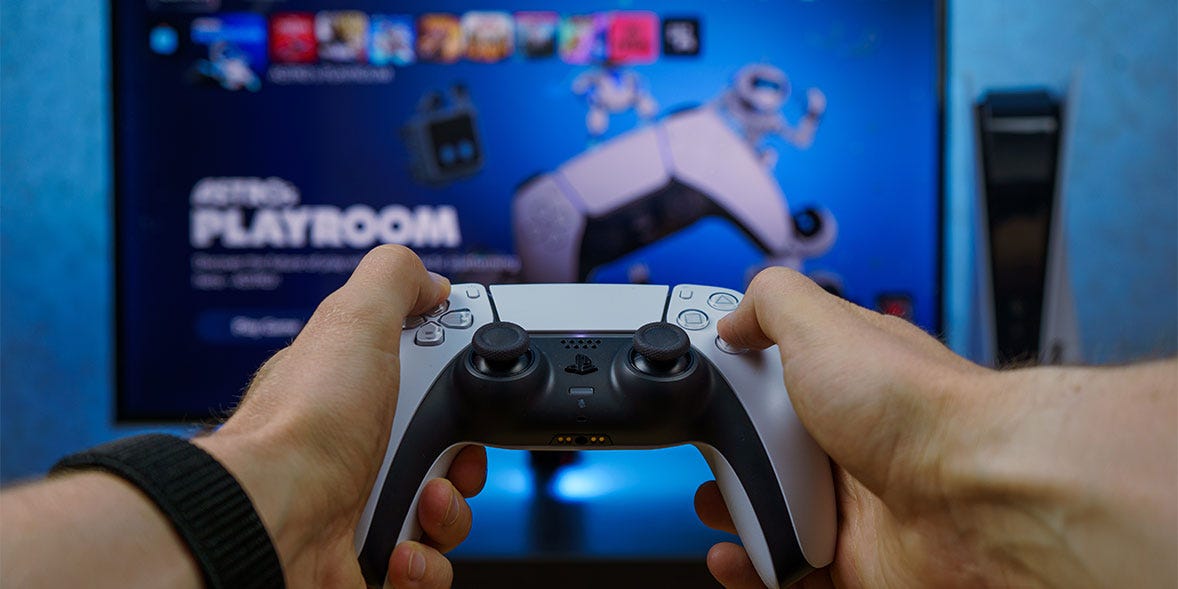
A while back I was asked over a post-event beer hypothetically how many ways a player might ‘interact’ with an AI in a video game. I came up with the following list in the space of around two or three minutes:
You’re in a single player game and interacting with an in-game AI system. This could be a non-player character or a system that exists without any in-game avatar (e.g. strategic opponent in StarCraft or X-COM). These interactions could be competitive, adversarial, or cooperative fashion.
You could have parts of the game experience be affected by a Director AI (e.g. Left 4 Dead) that is modelling player behaviour and reacting to it accordingly.
You could also cause some part of the game to trigger a Procedural Generation algorithm - which I stand by my opinion is a form of AI given its content creation driven by an algorithmic process powered by designer intent and knowledge.
The characters are benefitting from use of AI-driven animation controllers to ensure their movement looks really crisp and smooth in the moment.
You figure why not play your favourite online shooter on your PS5 Pro, and having splurged on the new 4K TV you decide to turn on the PlayStation Spectral Super Resolution, powered by Generative AI. Plus it could also be using the likes of Neural Texture Compression which games like God of War: Ragnarok and Assassin’s Creed: Mirage have adopted to keep the install size a little lower.
You go ahead and edit your in-game emblem. This user-generated content was achieved courtesy of the game connecting to an external Generative AI tool (think like EA College Football 25’s integration albeit in-game).
You start searching for match, and now the game is using using AI in some capacity as part of matchmaking. This ranges from the likes of TrueSkill used on the Xbox Network, to a variety of Engagement Optimised Matchmaking (EOMM) algorithms that are used by companies ranging from EA to NetEase.
Once online you jump into a game a trounce the opposition, you will then benefit from an AI-driven toxicity detection system that blocks or obfuscates chat messages sent to you because those weak-willed keyboard warriors on the other end can’t keep up with your mad skills.
Also you’re getting old and reading the in-game chat on my TV from across the room is getting difficult, so you use an AI-enabled accessibility tool to read the text chat aloud into your headset.
Meanwhile you’re chatting verbally with your friends via the in-game chat using the built-in microphone on your PlayStation 5’s controller. Thankfully your voice comes through crystal clear courtesy of the AI-powered noise cancellation built into PlayStation’s communication tools.
During your current match you pull off a cool headshot and want to reminisce about it at a later date. So you use the PS5’s built-in voice commands to capture the last 30 seconds of play.
But then the next game you’re on you might see a player get pulled out of the game mid-match, because they activated their wee cheat program they bought off some guy on Reddit and the (AI-enabled) anti-cheat software detected it.
After a run of bad luck, you quite and head to the in-game store, and it’s offering you a series of bundles for cosmetics and similar items which may well have been suggested courtesy of an AI algorithm.
You get fed up, decide to go out for a walk to the local shop for some ice cream. On the way you pull out your phone and play some rounds of Pokémon Go, a game that utilises some forms of AI as part of the depth perception and placement of the user as they overlap between physical and virtual worlds.
Now some of these are triggered by playing the game, looking at the screen, talking to others while playing the game, or simply exploring the options available to you. Only the first couple directly occur because you directly interacted with the system, but I guess the big question is how much does one ‘interact’ for it to count in this instance? It’s an open question that I hope someone a little more fluent in legalese can qualify.
But also, while much of this can potentially be signed off as ‘Minimal’, there are some areas that sound like they transition into Limited-Risk? There’s a real risk that by dismissing a lot of video game content as Minimal without really understanding the shifting landscape of AI in games, it could lead to issues in the future.
How Much AI is European AI?
There is of course the all important caveat of what the European Union considers as Artificial Intelligence. Per the definitions section of the EU AI Act:
‘AI system’ means a machine-based system that is designed to operate with varying levels of autonomy and that may exhibit adaptiveness after deployment, and that, for explicit or implicit objectives, infers, from the input it receives, how to generate outputs such as predictions, content, recommendations, or decisions that can influence physical or virtual environments;
Now they get into this in much more detail under Recital 12 which is far more thorough. There’s one part of this that is perhaps the most crucial in that it opens questions of what the EU considers ‘AI’ in the traditional sense:
A key characteristic of AI systems is their capability to infer. This capability to infer refers to the process of obtaining the outputs, such as predictions, content, recommendations, or decisions, which can influence physical and virtual environments, and to a capability of AI systems to derive models or algorithms, or both, from inputs or data. The techniques that enable inference while building an AI system include machine learning approaches that learn from data how to achieve certain objectives, and logic- and knowledge-based approaches that infer from encoded knowledge or symbolic representation of the task to be solved. The capacity of an AI system to infer transcends basic data processing by enabling learning, reasoning or modelling.
Now there is room to debate the particulars here, but it’s clear that this is written with a focus on Machine Learning-based approaches whereby AI is able to reason about data and learn from it in pursuit of updating a model focussed on a specific set of objectives. There’s a big difference between 'inference’ in the ML-sense from the likes of traditional Symbolic AI search algorithms and even simple automated reasoning used in everything from Finite State Machines and Behaviour Trees commonly used in Game AI. So when I have discussed this among lawyer friends we’ve generally concluded that Game AI isn’t really considered AI in the eyes of EU law, but also there does seem to be some wriggle-room, given they do explicitly state “encoded knowledge or symbolic representation” of tasks.
Now this brings what is for me two important considerations:
If Game AI/Symbolic AI is considered AI in the eyes of EU law, at what level do we consider the design and implementation of gameplay systems as ‘interacting’ with the user?
Is this interaction, as per the definition above, so ‘obvious’ in the eyes of the law it is ignored?
Which would be amusing given players seldom grasp this interaction never mind lawyers.
If Game AI is not considered AI in the eyes of EU law, how do we grapple with the fact that we can achieve many different features within video games using ‘old school’ techniques versus Machine Learning? What might be considered ‘not’ AI in the eyes of the law now could very well change in the years that follow.
That last point I raise a lot when people seek to classify AI in games, given for some situations where ML-related methodologies are the only way to achieve a given feature (e.g. image upscaling), there is equally many situations like say building Non-Player Characters where I could do it with Generative AI, with Machine Learning, with traditional Game AI, or just slap a bunch of lines of code in there and add some random number generator to give the perception of intelligence.
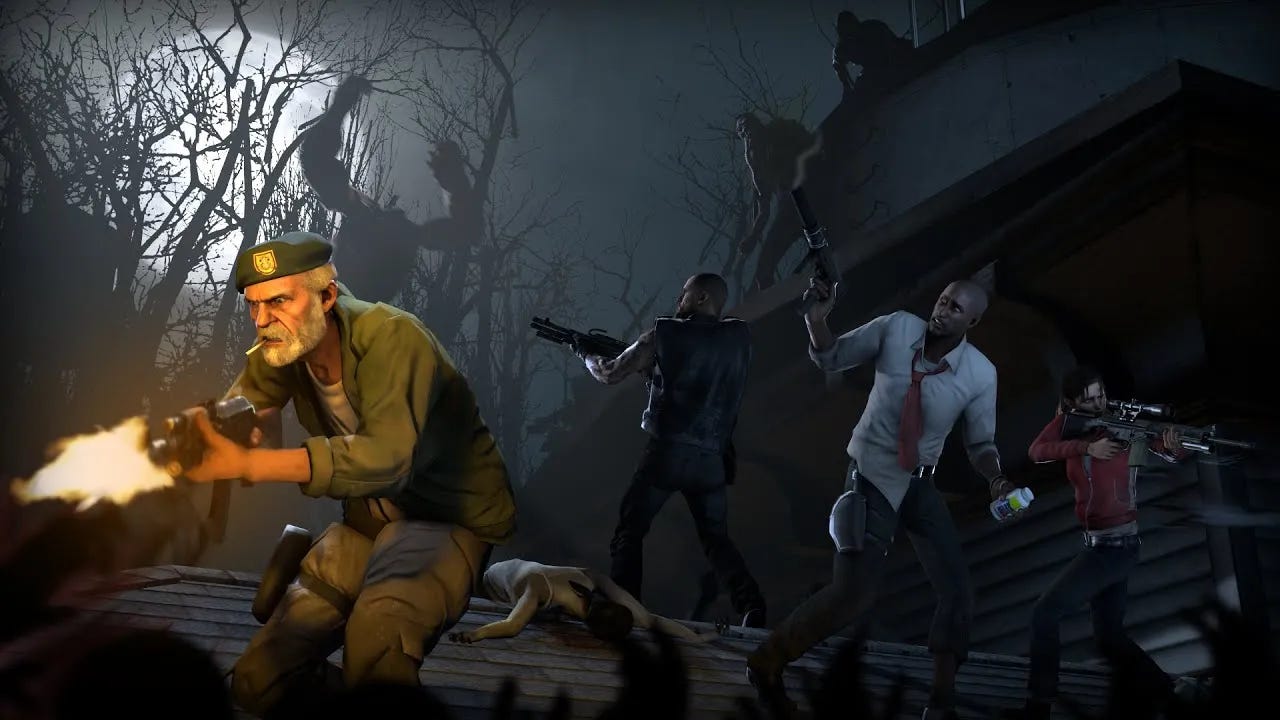
For example, one item mentioned in the ‘Limited-Risk’ AI system list is an emotion recognition system used for entertainment purposes. We could be reading player data as means to determine their emotion and use that to help us act in the moment. Naturally there are GDPR rules to consider if we harvest personal data, but we can also do that without learning anything personal about the user - or at least is not defined as personal. Left 4 Dead attempts to measure stress through a rather crude mechanism (damage dealt vs distance delta) to determine target prioritisation. It isn’t trying to model an emotion, only trigger it. Is that considered acceptable? Of course we could now go one step further and begin to determine the emotional reaction that’s coming from that stress and use that to learn more about each player and how to push their buttons. Does that need to flagged now as limited-risk if I used machine learning? But is it okay if I did it with a crude utility algorithm and a Finite State Machine?
Some Legal Insight
There has been some musings on this publicly in the legal world, and nothing I’ve heard has convinced me as yet. Right now the general consensus is that video game AI falls under the minimal risk obligations, and therefore disclosure should equally be relatively minimal. But with the field changing quite drastically at the moment, who is to say that stays the same? This applies not just to the transparency disclosures, but equally the rules on AI literacy for studios shipping games. Plus again how we implement AI in our games and why is an important aspect of consideration.
First up, Sheppard, Mullin, Richter & Hampton LLP wrote in 2025 that
“the [European Commission] stated that, in principle, AI-enabled video games face no obligation under the AI Act, but companies could voluntarily adopt additional codes of conduct (see AI Act | Shaping Europe’s digital future). It should be borne in mind, however, that in specific cases such as those described in this section, the AI Act will apply.”
I once again question how strong a grasp they have of the shifting landscape of AI in game development.
More recently Travers Smith LLP wrote about this recently and they argued that “NPCs in a single-player video game, where the nature of the game makes clear that no other people can participate” is an ‘obvious’ use and doesn’t require disclosure. But I don’t really agree with that either, given you don’t know whether we’re using player data to influence the behaviour of this interaction, and it may well be adapting over time. The game might be pulling telemetry to update or influence either in the moment, or for other players in the future. The original Forza Horizon ‘Drivatars’ have you race against NPCs that are being updated from other players data. So my experience is being affected by that is inferring from knowledge it attained from another players gameplay. To assume all these interactions are synchronous and concurrent again doesn’t really reflect modern gaming.

Lastly Bird & Bird LLP wrote that “real-time ephemeral content, in video games or virtual reality for example, is exempt only where marking is not technically feasible and users are made aware of the AI origin through experience-level or session-level disclosure.” So how many disclosures do I need to put into Call of Duty which has both a single and multiplayer component where each uses a variety of AI implementations for different purposes?

Perhaps I’ve being too grumpy this? Am I over thinking it? I just feel like I am repeatedly coming up against vague definitions that don’t help answer my question. I appreciate we need these things to be vague enough that it applies across the board, but it feels like most guidance on this issue speaks to a fundamental lack of knowledge of how AI works in games and also how AI is beginning to change within the industry itself.
The Future of AI Governance in Games?
I am surprised that thus far we’ve heard nothing on this from PEGI - the Pan-European Game Information ratings board. I figured given the EU AI Act has a requirement for bodies to act as central authorities for some of this, that we’d at least see an effort to perhaps add a new GenAI qualifier in the PEGI ratings in much the same way we had in-game purchases and gambling (i.e. loot boxes).

Of course relying on PEGI isn’t ideal given the vast majority of games don’t ever apply for a rating. Games on Steam are required to use their built-in content survey in Steamworks. It’s only really big-budget titles that wind up on store shelves (for now at least) and console titles that wind up getting this classification in place.
I imagine we’re going to see a lot more clarity on this in the years ahead. Notably because games are now shipping in this new AI-disclosure world. But it strikes me that like much of how the EU AI Act has been executed on, we’re left with more questions than answers.
Wrapping Up
Thanks for sticking with me to the end of this ramble! There was much to discuss it seems. Also I’m open to any of my lawyer friends who have some more clarity on this to chip in. I feel like the ‘one size fits all’ approach given to much of video game disclosure feels incredibly naïve and runs risk of creating problems for the industry in the long run.
Alright, that’s it for this edition. I have work to do. I also need to lie down. Take care and we’ll catch you next week!